Maine Paycheck Calculator
Determine your net take-home salary in the Pine Tree State. This tool computes federal tax, FICA, pre-tax deductions, and the progressive Maine state tax.
Estimated Take-Home Pay
per bi-weekly pay period
Detailed Deductions Breakdown
Navigating Maine's progressive income tax on your paycheck
Analyzing a new job offer or looking at a pay stub in Maine requires going beyond the gross salary. Because Maine uses a progressive individual tax structure, the percentage of state tax deducted increases as you move up in income. The tax brackets range from 5.8% up to a top tier of 7.15% for high-income earners.
Let's trace a standard baseline. If you earn an annual gross salary of $95,000 as a single filer with no pre-tax contributions, Maine will take $4,799.90 in state income taxes for the year. Once federal taxes and FICA are deducted, your net take-home pay is $70,862.60.
Assuming a typical bi-weekly schedule—which yields 26 paychecks in a year—you will receive approximately $2,725.48 per pay period. You can run comparative calculations above for your salary, or continue reading to learn how Maine's tax structure impacts your checks.
Maine Take-Home Pay Snapshot
Below is the distribution of a $95,000 baseline annual salary for a single Maine taxpayer.
Analyzing the paycheck of a $95,000 earner
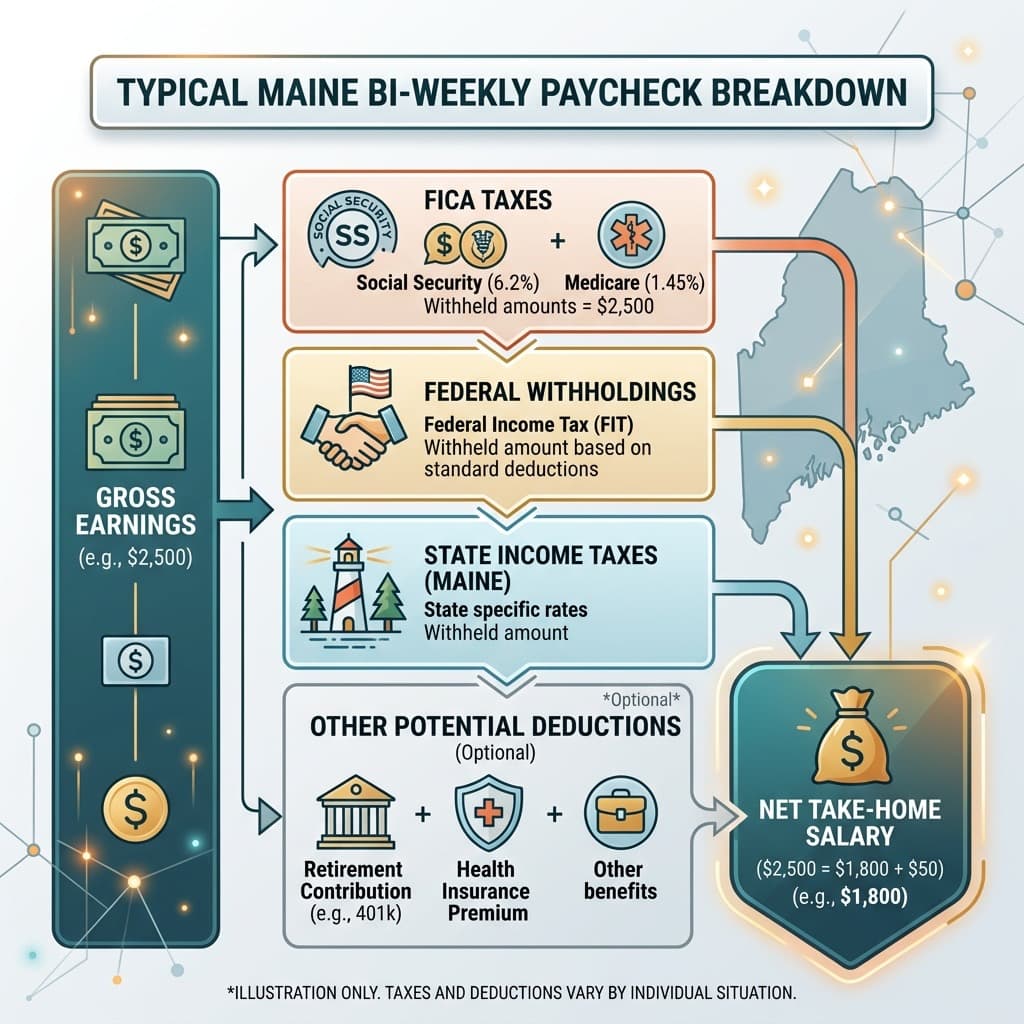
Visualizing the path from your gross wages to your net pay stub makes tax planning much simpler. Below is the detailed bi-weekly paycheck breakdown of a single filer earning a gross annual wage of $95,000 with standard deductions and no pre-tax savings.
| Type of Withholding | Annual Total | Bi-Weekly Paycheck |
|---|---|---|
| Gross Earnings | $95,000.00 | $3,653.85 |
| Federal Income Tax | -$12,070.00 | -$464.23 |
| FICA Tax (SS & Medicare) | -$7,267.50 | -$279.52 |
| Maine State Income Tax | -$4,799.90 | -$184.61 |
| Net Take-Home Pay | $70,862.60 | $2,725.48 |

A bi-weekly paycheck walk-through for a $104,000 salary
Let's trace how standard workplace deductions impact your check. Suppose you earn a gross salary of $104,000 a year, file as single, and are paid bi-weekly. You decide to contribute 6% of your gross wages to a pre-tax 401(k) ($240.00 per paycheck) and pay $100.00 per period for medical insurance premiums.
Applying these figures yields the following bi-weekly paycheck deductions:
- Gross Period Pay: $4,000.00
- Social Security (6.2% of FICA base): $241.80
- Medicare (1.45% of FICA base): $56.55
- Maine State Income Tax (progressive brackets): $185.05 (based on annualized taxable income of $74,560.00)
- Federal Income Tax (FIT): $465.58
- Total Deductions: $1,288.99 (includes taxes plus your retirement and health contributions)
- Net Take-Home Pay: $2,711.01
Personal exemptions and standard deductions in the Pine Tree State
Maine is one of the few states that continues to support a state-level personal exemption alongside the standard deduction. For the 2026 tax year, the standard deduction matches the federal baseline at $15,300 for single filers. Additionally, the personal exemption is $5,300 per filer (which is doubled for married couples filing jointly).
Together, these exemptions shield a total of $20,600 of your annual wages from state taxation from the very first dollar. This means that a single earner making $95,000 only pays Maine's progressive income tax on $74,400 of their income. This helps offset the higher progressive brackets for lower and middle-income earners.
How Maine compares to other New England tax systems
If you live near the border or are considering a move, it's helpful to see how Maine's tax rates compare to surrounding states:
- New Hampshire: Levies no tax on earned wages, which is a major draw for workers in northern New England.
- Massachusetts: Levies a flat 5.0% income tax on most income, but adds a high-income surcharge on earnings over $1,000,000. You can read more about Massachusetts tax policies on the official Massachusetts Department of Revenue website.
- Connecticut: Has progressive brackets ranging from 2.0% to 6.99%.
While Maine's top bracket of 7.15% is higher than some of its neighbors, the state's generous standard deduction and personal exemption help offset the tax burden for low and middle-income earners. For official guidelines on Maine tax rules, check the Maine Revenue Services portal.
Maximizing your take-home pay through retirement savings
The most effective way to keep more of your paycheck is to lower your taxable income. You can do this by maximizing contributions to pre-tax accounts, such as a traditional 401(k), 403(b), or a Health Savings Account (HSA).
Since Maine calculates state taxable income starting from your federal adjusted gross income, every pre-tax dollar you save lowers both your federal income taxes and your progressive Maine state taxes. For high earners, this is an excellent strategy to grow retirement savings while reducing current tax liabilities.
Maine Payroll Tax FAQs
Clear, expert answers to key questions about paycheck deductions, state tax rates, and standard deductions in Maine.
Other State Paycheck Calculators
Connecticut Paycheck Calculator
Calculate take-home pay with Connecticut's progressive brackets (2.0% - 6.99%) and personal exemptions.
Delaware Paycheck Calculator
Calculate take-home pay with Delaware's progressive brackets and state credit adjustments.
Kansas Paycheck Calculator
Calculate take-home pay with Kansas' two-bracket progressive tax system and standard exemptions.
Florida Paycheck Calculator
Calculate payroll take-home pay in Florida, which has no state income tax deductions.