Delaware Paycheck Calculator
Calculate your Delaware net check and take-home pay. Adjusts for federal income taxes, FICA withholding, Delaware's progressive tax brackets (0% - 6.6%), personal credits, and the 0.40% PFML premium.
Estimated Take-Home Pay
per bi-weekly pay period
Detailed Deductions Breakdown
How Much of an $85,000 Salary Do You Keep in Delaware?
If you earn a gross salary of $85,000 a year while living and working in Delaware, you won't take all of it home. After factoring in federal income taxes, FICA contributions, state taxes, and the state's paid leave program, a single filer with no pre-tax benefits ends up with an annual net pay of $64,019.
Assuming you are paid on a bi-weekly schedule (which translates to 26 pay periods per year), your net check will come out to approximately $2,462.
This final number is calculated by subtracting federal taxes (which you can estimate on our main Federal Paycheck Calculator), Social Security, Medicare, Delaware progressive state taxes (SIT), and the state's Paid Family and Medical Leave (PFML) premium from your gross earnings.
Delaware Take-Home Pay Snapshot
Here is how a baseline annual salary of $85,000 (Single filer, standard deductions, with zero retirement or health allocations) breaks down after federal and state payroll taxes in 2026.
Walking Through a Delaware Paycheck: A Real-World Example
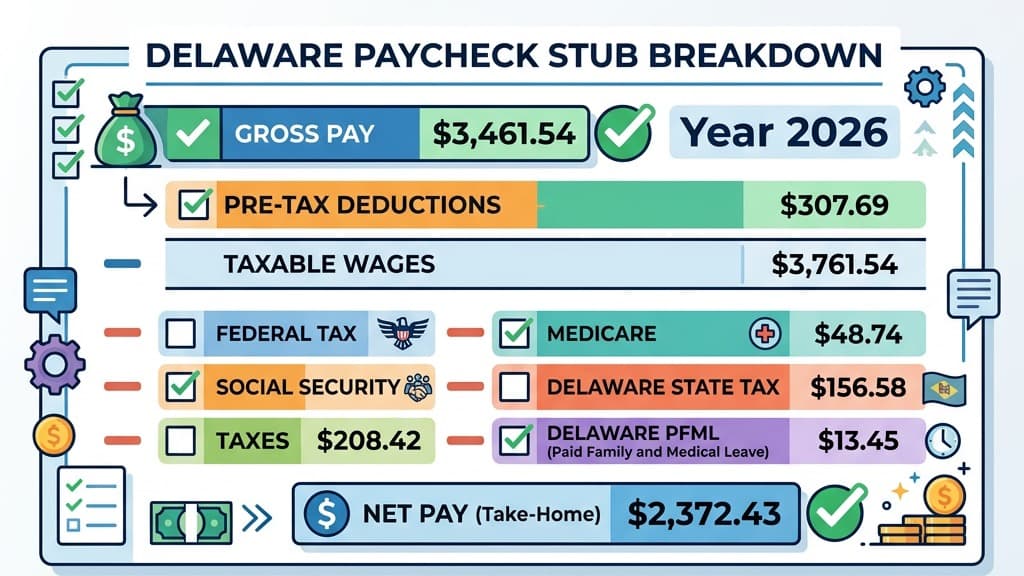
To see how tax regulations and employee benefits interact on a real paycheck stub, let's run through a step-by-step example. We'll use a gross annual salary of $90,000 (which is $3,461.54 gross per bi-weekly paycheck). This employee files as Single, contributes 6% ($207.69) of their gross earnings to a traditional 401(k), and pays $100.00 per period for employer-sponsored health insurance.
When standard payroll calculations are processed, here is how the deductions stack up per paycheck:
- Gross Period Pay: $3,461.54
- Social Security (6.2% of FICA-taxable wages): $208.42
- Medicare (1.45% of FICA-taxable wages): $48.74
- Delaware Paid Family Leave premium (0.40%): $13.45
- Federal Income Tax withholding: $354.23 ($9,210 annually)
- Delaware State Income Tax: $156.58 ($4,071 annually)
- Total paycheck deductions: $1,089.11 (including 401k and medical)
- Net paycheck (Take-Home amount): $2,372.43
How Do Delaware's Progressive State Tax Brackets Impact Your Income?
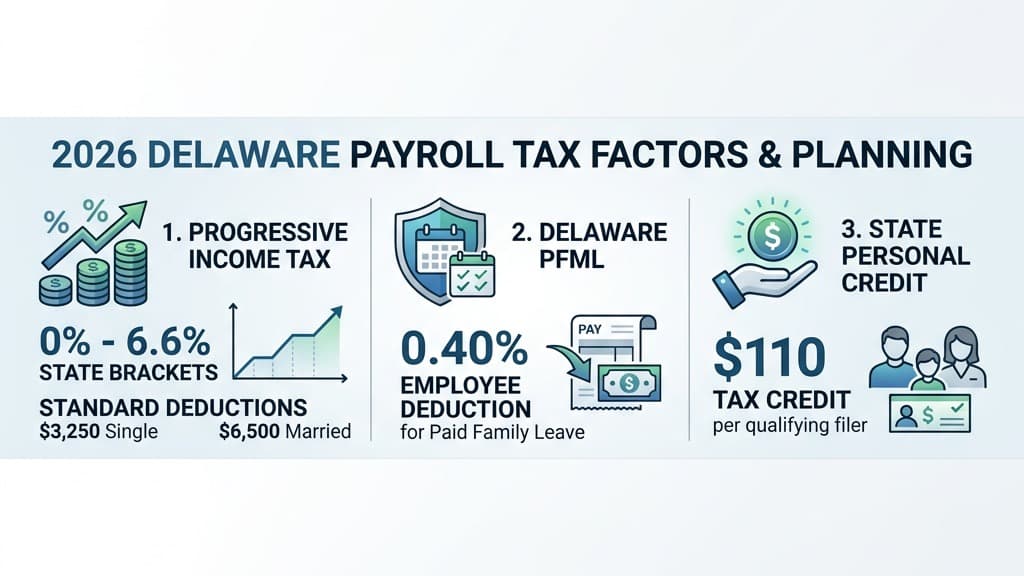
Unlike states with a single flat rate, such as neighboring Georgia (4.99% flat) or states with zero income tax like Florida, Delaware uses a seven-tiered progressive tax code. Rates start at 0.00% for the first $2,000 of taxable income and rise up to a maximum rate of 6.60% on taxable income exceeding $60,000.
To determine your state taxable income, you start with your adjusted gross income and subtract the state standard deduction: $3,250 for Single filers and $6,500 for Married filing jointly. Delaware also provides a $110 personal tax credit for each filer and dependent ($220 for married joint filers), which is deducted dollar-for-dollar from your final state tax liability.
What is the Delaware Paid Family and Medical Leave Deduction?
Delaware workers contribute to the state's Paid Family and Medical Leave (PFML) program. Designed to fund employee family care, child bonding, and medical leave benefits, the program is funded by a flat payroll contribution of 0.80% of covered wages.
By law, employers are permitted to split this premium with workers, resulting in a maximum employee-paid deduction of 0.40%. This premium applies directly to your FICA-taxable wages and is capped at the annual Social Security taxable wage limit ($184,500 in 2026).
State income tax withholding amounts, on the other hand, are calculated based on Withholding Allowances documented on Form DE-W4, which you submit directly to your employer when starting a job.
Living in Delaware and Working Out-of-State: How Does Commuter Tax Work?
If you live in Delaware but commute to work in neighboring Pennsylvania, Maryland, or New Jersey, you might wonder about double taxation.
Delaware residents are required to file a resident tax return declaring all income, regardless of where it was earned. However, Delaware prevents double taxation by offering a resident credit for income taxes paid to other states. You'll file a non-resident return in the state where your office is located, pay taxes there, and then claim a credit on your Delaware resident tax return.
Delaware Payroll Tax FAQs
Clear, expert answers to key questions about paycheck deductions, progressive tax brackets, and paid family leave in Delaware.
Other State Paycheck Calculators
Connecticut Paycheck Calculator
Calculate take-home pay with Connecticut progressive tax brackets (2% - 6.99%) and 0.50% Paid Leave.
California Paycheck Calculator
Calculate payroll take-home pay in California with progressive SIT (1% - 13.3%) and 1.30% SDI deductions.
Colorado Paycheck Calculator
Calculate take-home pay with Colorado's flat 4.40% state income tax rate and 0.44% FAMLI deductions.
Arkansas Paycheck Calculator
Estimate take-home earnings with Arkansas' progressive tax brackets (0% - 3.7%) and Form AR4EC elections.