Connecticut Paycheck Calculator
Calculate your Connecticut net check and take-home pay. Adjusts for federal income taxes, FICA withholding, Connecticut's graduated tax brackets (2% - 6.99%), and the 0.50% CT Paid Leave premium.
Estimated Take-Home Pay
per bi-weekly pay period
Detailed Deductions Breakdown
How Much of a $115,000 Salary Do You Keep in Connecticut?
If you bring home a gross annual salary of $115,000 in Connecticut, the state's multi-tiered progressive tax code and mandatory paid leave program will leave a single filer with a net take-home pay of roughly $83,508.
Assuming you are paid on a standard bi-weekly schedule (which equals 26 paychecks a year), each check will deposit approximately $3,212 into your account after federal, state, and local withholdings.
This take-home pay is the final remainder after your employer processes federal income taxes (calculable on our Federal Paycheck Calculator), FICA withholdings, Connecticut progressive state taxes (SIT), and the state's Paid Leave (CT PL) contribution.
Connecticut Take-Home Pay Snapshot
Here is how a baseline annual salary of $115,000 (Single filer, standard deductions, with zero retirement or health allocations) breaks down after federal and state payroll taxes in 2026.
How Do Benefit Deductions Adjust Your Take-Home Check?
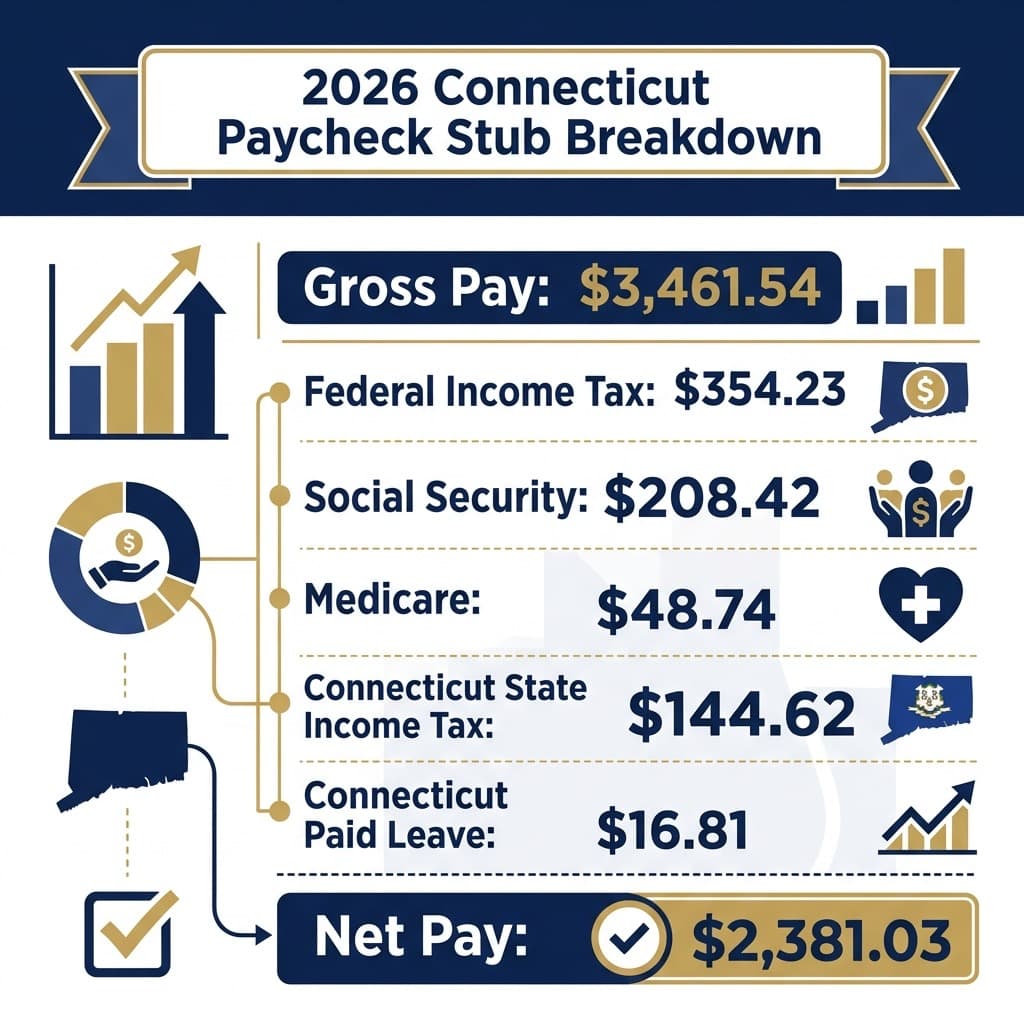
If you contribute to a traditional 401(k) or pay health insurance premiums directly from your check, these allocations reduce your taxable base. Let's look at an employee earning a gross annual salary of $90,000 (which is $3,461.54 gross per paycheck). This employee files as Single, contributes 6% ($207.69) to a traditional 401(k), and pays $100.00 per period for medical premiums.
By running this through standard payroll calculations, here is how the deductions stack up per paycheck:
- Gross Period Pay: $3,461.54
- Social Security contribution (6.2% of FICA-taxable wages): $208.42
- Medicare contribution (1.45% of FICA-taxable wages): $48.74
- Connecticut Paid Leave premium (0.50%): $16.81
- Federal Income Tax withholding: $354.23 ($9,210 annually)
- Connecticut State Income Tax (progressive): $144.62 ($3,760 annually)
- Total paycheck deductions: $1,080.51 (including 401k and medical)
- Net paycheck (Take-Home amount): $2,381.03
How Do Connecticut's Seven Progressive Brackets Work?
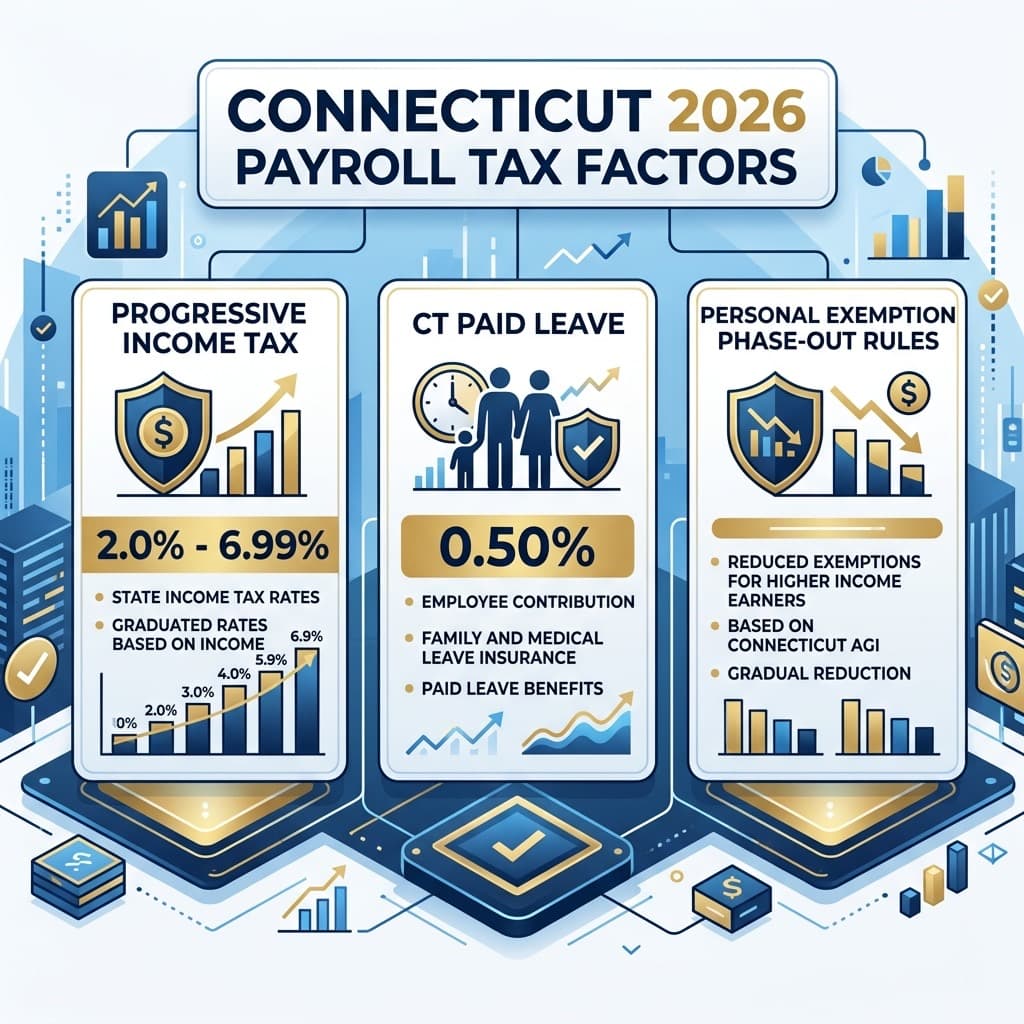
Connecticut uses a highly progressive, seven-tier tax schedule, scaling from a low of 2.00% up to a top rate of 6.99%. This progressive scaling represents a significant tax burden compared to flat-tax states like Colorado (4.40%) or Arizona (2.50%).
| Tax Rate | Single Filers (CT AGI) | Married Jointly (CT AGI) |
|---|---|---|
| 2.00% | $0 to $10,000 | $0 to $20,000 |
| 4.50% | $10,001 to $50,000 | $20,001 to $100,000 |
| 5.50% | $50,001 to $100,000 | $100,001 to $200,000 |
| 6.00% | $100,001 to $200,000 | $200,001 to $400,000 |
| 6.50% | $200,001 to $250,000 | $400,001 to $500,000 |
| 6.90% | $250,001 to $500,000 | $500,001 to $1,000,000 |
| 6.99% | $500,001 or more | $1,000,001 or more |
Why is the Connecticut Personal Exemption So Complex?
Unlike other states that offer standard deductions, Connecticut uses a graduated **Personal Exemption** ($15,000 for Single / $24,000 for Married). These exemptions phase out completely for high-earning filers: the single exemption starts declining once CT Adjusted Gross Income (CT AGI) crosses $30,000, reducing to $0 once income exceeds $44,000.
What is the Bracket Recapture and How Does It Penalize Higher Earners?
Additionally, Connecticut implements a **tax bracket recapture** mechanism. Under this rule, high-earning taxpayers must pay back the benefits of the lower 2.0% and 4.5% tax tiers, effectively subjecting their entire income to the higher marginal rates. This makes state-level calculations complex for high earners.
How Does the 0.50% CT Paid Leave Payroll Deduction Work?
Connecticut employees are subject to a flat 0.50% Paid Leave premium. Managed by the Connecticut Paid Leave Authority, this deduction funds paid family and medical leave benefits.
This premium is deducted from your FICA taxable wages and is capped at the annual Social Security wage limit of $184,500. This is separate from state income taxes, which are withheld based on Withholding Codes claimed on Form CT-W4 submitted to the Connecticut Department of Revenue Services (DRS).
Connecticut Payroll Tax FAQs
Clear, expert answers to key questions about paycheck deductions, progressive tax brackets, and paid family leave in Connecticut.
Other State Paycheck Calculators
Alabama Paycheck Calculator
Calculate take-home pay with Alabama state income tax brackets (2% - 5%) and federal tax deductibility.
Alaska Paycheck Calculator
Calculate payroll take-home pay in Alaska, which features zero state income tax and a 0.50% SUI deduction.
Arizona Paycheck Calculator
Calculate take-home pay with Arizona's flat 2.50% state income tax rate and Form A-4 elections.
Colorado Paycheck Calculator
Estimate take-home earnings with Colorado's flat tax rate (4.40%) and 0.44% FAMLI deductions.