California Paycheck Calculator
Calculate your California net check and take-home pay. Accounts for federal income taxes, FICA withholding, progressive state tax rates (up to 13.3%), and the 1.30% SDI tax.
Estimated Take-Home Pay
per bi-weekly pay period
Detailed Deductions Breakdown
How Much Cash Hits Your Account from a $125,000 California Salary?
Earning a $125,000 gross salary in California sounds substantial, but the state's progressive tax brackets mean your actual net check will look quite different. After federal withholdings, state taxes, and mandatory payroll contributions are deducted, a single filer in California will bring home about $87,546 per year.
For employees on a typical bi-weekly pay cycle (26 paychecks annually), this translates to an average take-home deposit of $3,367 every two weeks.
Understanding this check size requires looking at federal income tax (FIT) parameters, which you can model on our Federal Paycheck Calculator, FICA taxes, California's progressive Personal Income Tax (PIT), and State Disability Insurance (SDI).
California Take-Home Pay Snapshot
Here is the annual breakdown of a baseline $125,000 salary (Single status, standard deductions, with zero retirement or health allocations) in 2026.
How Do Pre-Tax Contributions Alter Your Check?
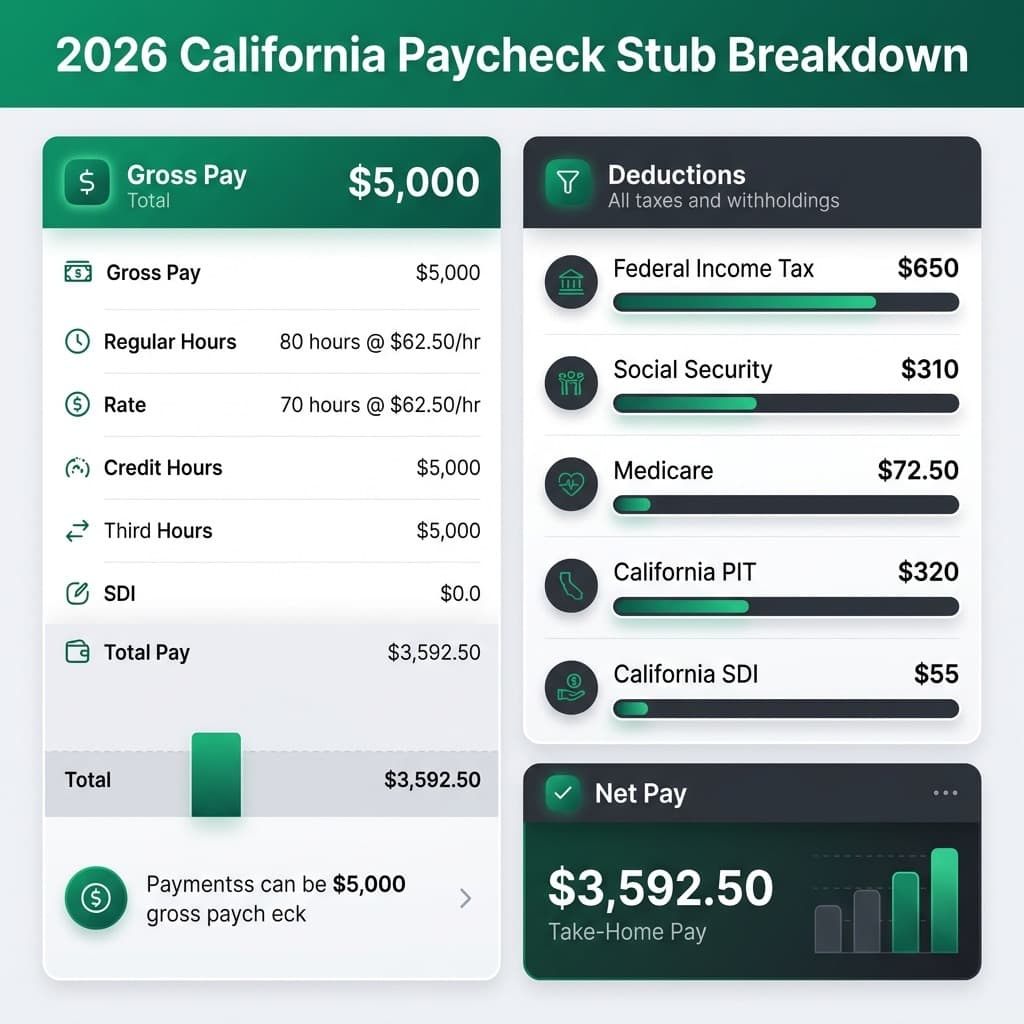
If you contribute to a traditional 401(k) or pay medical insurance premiums directly from your check, these benefits lower your taxable wages. Let's look at a bi-weekly check for an employee earning a gross annual salary of $90,000 (which is $3,461.54 per paycheck). This employee contributes 6% ($207.69) to a traditional 401(k) and has $100.00 deducted for health insurance.
By running this through standard payroll progression, here is how the deductions stack up:
- Gross Period Pay: $3,461.54
- Social Security contribution (6.2%): $208.42
- Medicare contribution (1.45%): $48.74
- California SDI (1.30% flat): $43.70
- Federal Income Tax withholding (progressive): $354.23 ($9,210 annually)
- California State Income Tax (progressive): $135.92 ($3,533.98 annually)
- Total paycheck deductions: $791.01
- Net paycheck (Actual Take-Home): $2,362.84
What is the Mental Health Services Surcharge?
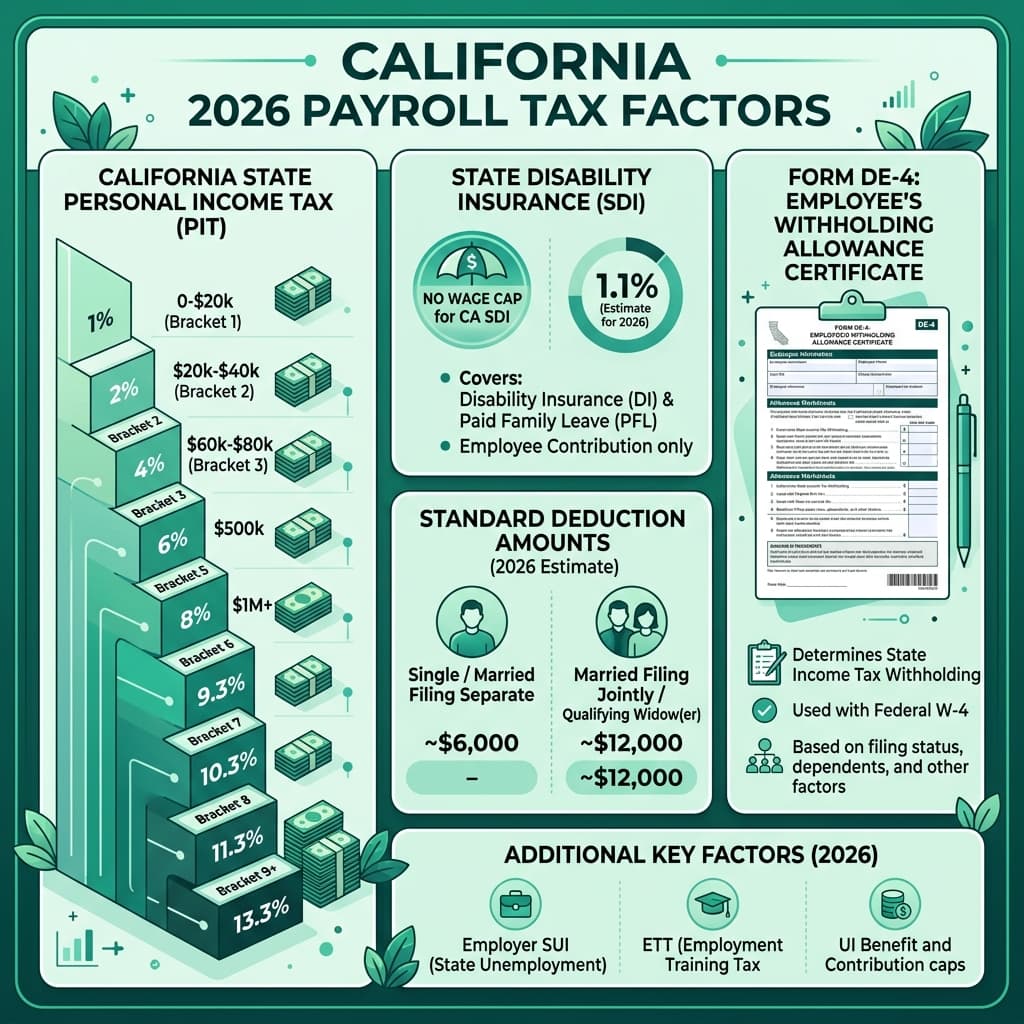
California operates a progressive state income tax with nine tax brackets ranging from 1.0% up to 12.3%. It represents one of the steepest tax environments in the United States, particularly when compared to flat-tax states like Arizona (2.50% flat) or zero-tax states like Alaska.
For individuals whose annual taxable income exceeds $1,000,000, California levies an additional 1.0% tax under the Mental Health Services Act (MHSA). This surtax raises the top marginal rate to 13.3%, affecting all high-earning professionals in the state. Standard deductions protect some baseline income, shielding $5,706 for single filers and $11,412 for married joint filers.
Why is California State Disability Insurance (SDI) Uncapped?
A significant factor for California payrolls is the State Disability Insurance (SDI) withholding. SDI contributions fund both disability coverage and California's Paid Family Leave (PFL) benefits.
For the 2026 tax year, the SDI rate is set at a flat 1.30% of gross wages. In a recent legislative shift, California eliminated all taxable wage ceilings for SDI. Previously, deductions stopped once you cleared a certain wage base. Now, the 1.30% SDI tax applies to every single dollar of earned income, meaning high earners continue to pay this levy throughout the entire year with no cap.
Should You Fill Out a Separate California Form DE-4?
When starting a job, your employer will ask you for federal withholding selections via Form W-4, but you should also request to file a separate state-specific Form DE-4, regulated by the California Employment Development Department (EDD).
Form DE-4 allows you to claim state-specific allowances that do not exist on the federal Form W-4. If you do not submit a DE-4, your employer will default to your federal settings, which often leads to inaccurate state withholding and may result in an underpayment penalty when you file your state returns.
California Payroll Tax FAQs
Clear, expert answers to key questions about paycheck deductions and SDI tax rates in California.
Other State Paycheck Calculators
Alabama Paycheck Calculator
Calculate take-home pay with Alabama state income tax brackets (2% - 5%) and federal tax deductibility.
Alaska Paycheck Calculator
Calculate payroll take-home pay in Alaska, which features zero state income tax and a 0.50% SUI deduction.
Arizona Paycheck Calculator
Calculate take-home pay with Arizona's flat 2.50% state income tax rate and Form A-4 elections.
Colorado Paycheck Calculator
Estimate take-home earnings with Colorado's flat tax rate (4.40%) and 0.44% FAMLI deductions.