Florida Paycheck Calculator
Calculate your Florida net check and take-home pay. Adjusts for federal income taxes, FICA withholding, pre-tax savings, and Florida's zero-tax state structure.
Estimated Take-Home Pay
per bi-weekly pay period
Detailed Deductions Breakdown
What Does a $90,000 Salary Look Like After Taxes in Florida?
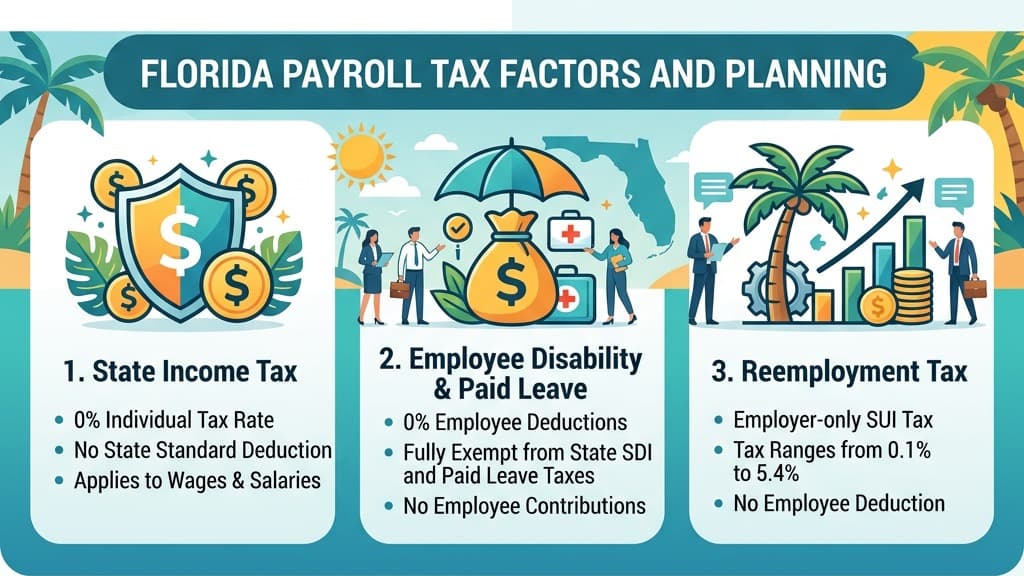
Florida's reputation as a tax haven is well-earned, thanks to a constitutional ban on state personal income taxes. For a single filer with a gross annual salary of $90,000, this lack of state income tax means keeping an estimated $72,145 of your annual earnings.
Assuming you are paid on a bi-weekly schedule (which equals 26 paychecks a year), each paycheck will deposit approximately $2,775 into your bank account.
Because Florida has no state-level personal income tax, your withholdings are limited to federal liabilities: Federal Income Tax (FIT) and FICA taxes (Social Security and Medicare). If you want to compare these numbers with other jurisdictions or calculate custom parameters, you can use our standard Federal Paycheck Calculator to run customized withholding scenarios.
Florida Take-Home Pay Snapshot
Below is the distribution of a $90,000 baseline annual salary for a single Florida filer taking the standard federal deduction.
How Do Pre-Tax Contributions Alter Your Florida Take-Home Pay?
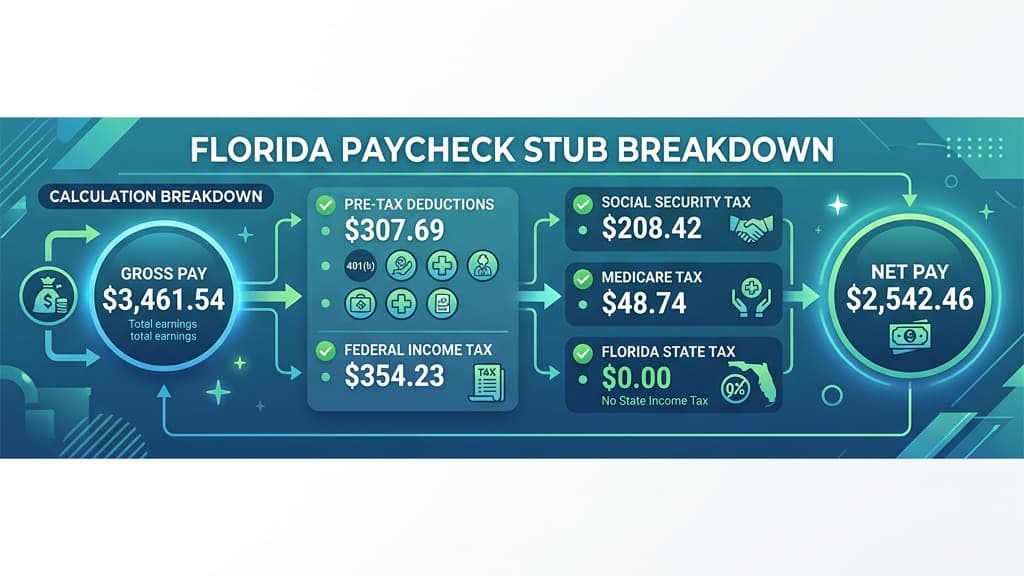
For employees curious about how individual deductions affect their paycheck stub, let's look at an example. Imagine a Florida employee with a gross salary of $90,000 per year who is paid bi-weekly (26 times a year). They elect a 6% pre-tax retirement contribution to a 401(k) ($207.69 per period) and have $100.00 deducted each paycheck for health insurance.
This results in the following paycheck calculations:
- Gross Period Pay: $3,461.54
- Social Security (6.2% of FICA-taxable base): $208.42
- Medicare (1.45% of FICA-taxable base): $48.74
- Florida State Income Tax (SIT): $0.00
- Federal Income Tax withholding (FIT): $354.23 (annualized to $9,210)
- Total paycheck deductions: $919.08 (including pre-tax contributions and taxes)
- Net Take-Home Pay: $2,542.46
How Do Remote Workers Protect Their Florida Income from Out-of-State Taxes?
Because Florida is an absolute tax oasis, many remote workers establish residency in the state while working for employers based in states with high personal income taxes like California. However, remote workers must remain vigilant. States with aggressive convenience-of-the-employer rules can sometimes tax out-of-state employees if their physical office is located elsewhere.
Establishing a true Florida domicile involves acquiring a local driver's license, registering to vote, and spending more than 183 days a year within the state. This protects your paycheck from audit triggers. Similar to other zero-income-tax states like Alaska, Florida has zero local or county-level income taxes, meaning your state tax liability is flat zero.
What is Florida's Reemployment Tax and Do Employees Pay It?
While states like Connecticut levy 0.50% paid leave premiums and Delaware requires a 0.40% PFML deduction, Florida has zero employee-paid state disability or family leave taxes.
The only significant payroll tax in Florida is the state unemployment tax, known as the Reemployment Tax. This is funded completely by employers. Florida businesses pay a rate between 0.10% and 5.40% on the first $7,000 of each worker's calendar year wages. Employers are strictly prohibited from deducting this cost from your paycheck.
How Do You Adjust Your Payroll Withholding in a Zero-Tax State?
Since Florida doesn't have state income tax, there is no state-level withholding form to submit. Any adjustments to your take-home pay must be managed through the federal Form W-4.
Employers use the W-4 to calculate federal withholding based on your filing status, dependents, and other income. Managing this form is the primary tool Florida employees have to maximize their net paycheck. For questions about employer tax registration or state business rules, visit the official portal of the Florida Department of Revenue.
Florida Payroll Tax FAQs
Clear, expert answers to key questions about paycheck deductions, state tax exemptions, and reemployment taxes in Florida.
Other State Paycheck Calculators
Connecticut Paycheck Calculator
Calculate take-home pay with Connecticut progressive tax brackets (2% - 6.99%) and 0.50% Paid Leave.
Colorado Paycheck Calculator
Calculate take-home pay with Colorado's flat 4.40% state income tax rate and 0.44% FAMLI deductions.
Delaware Paycheck Calculator
Calculate payroll take-home pay in Delaware with progressive SIT (0% - 6.6%) and 0.40% PFML deductions.
Alaska Paycheck Calculator
Estimate take-home earnings in Alaska, which features zero state income tax and a 0.50% SUI deduction.