Kansas Paycheck Calculator
Calculate your Kansas net check and take-home pay. Adjusts for federal income taxes, FICA withholding, pre-tax deductions, and Kansas' two-bracket progressive state income tax.
Estimated Take-Home Pay
per bi-weekly pay period
Detailed Deductions Breakdown
How Much of an $88,000 Salary Do You Keep After Kansas State Taxes?
Navigating payroll withholdings in the Sunflower State involves applying a conformed standard deduction and a generous personal exemption to your state taxable base, then passing it through a streamlined two-bracket progressive tax table. For a single employee earning a gross annual salary of $88,000 with no pre-tax benefits, this progressive tax structure results in a state income tax liability of $4,111 and a final net take-home pay of $66,627.
For professionals paid on a bi-weekly cycle—which yields 26 paychecks across the calendar year—this net package translates into a recurring deposit of approximately $2,563 per pay period.
This final net figure is calculated by subtracting federal income taxes (estimable using our Federal Paycheck Calculator), FICA withholdings, and Kansas flat state tax (SIT). To model custom deductions or run comparative scenarios, you can use our standard tools to run customized scenarios.
Kansas Take-Home Pay Snapshot
Below is the distribution of an $88,000 baseline annual salary for a single Kansas taxpayer.
Step by Step Walkthrough of a Biweekly Kansas Paycheck
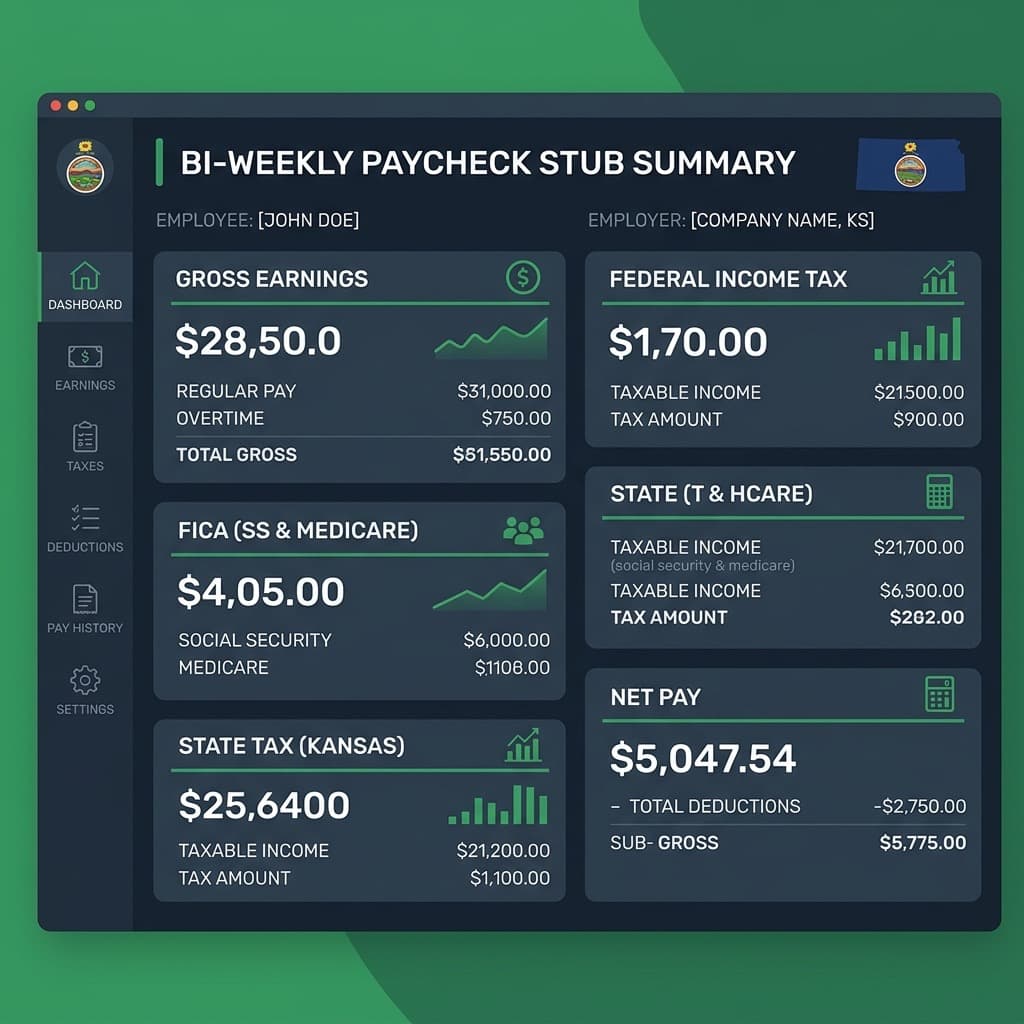
To see how these rules function on a real paycheck stub, let us follow a step-by-step example for an employee earning a gross annual salary of $98,000. This employee files as Single, works on a standard bi-weekly pay cycle (26 paychecks a year), contributes 6% of gross wages to a traditional pre-tax 401(k) ($226.15), and has $100.00 deducted per period for medical premiums.
This results in the following paycheck calculations:
- Gross Period Pay: $3,769.23
- Social Security (6.2% of FICA-taxable base): $227.49
- Medicare (1.45% of FICA-taxable base): $53.20
- Kansas State Income Tax (SIT - graduated brackets): $161.37 (annualized to $4,195.53)
- Federal Income Tax withholding (FIT): $417.86 (annualized to $10,864.40)
- Total paycheck deductions: $1,186.07 (including pre-tax contributions and taxes)
- Net paycheck (Take-Home amount): $2,583.16
Exemptions and Deductions that Lower Your Kansas Taxable Income
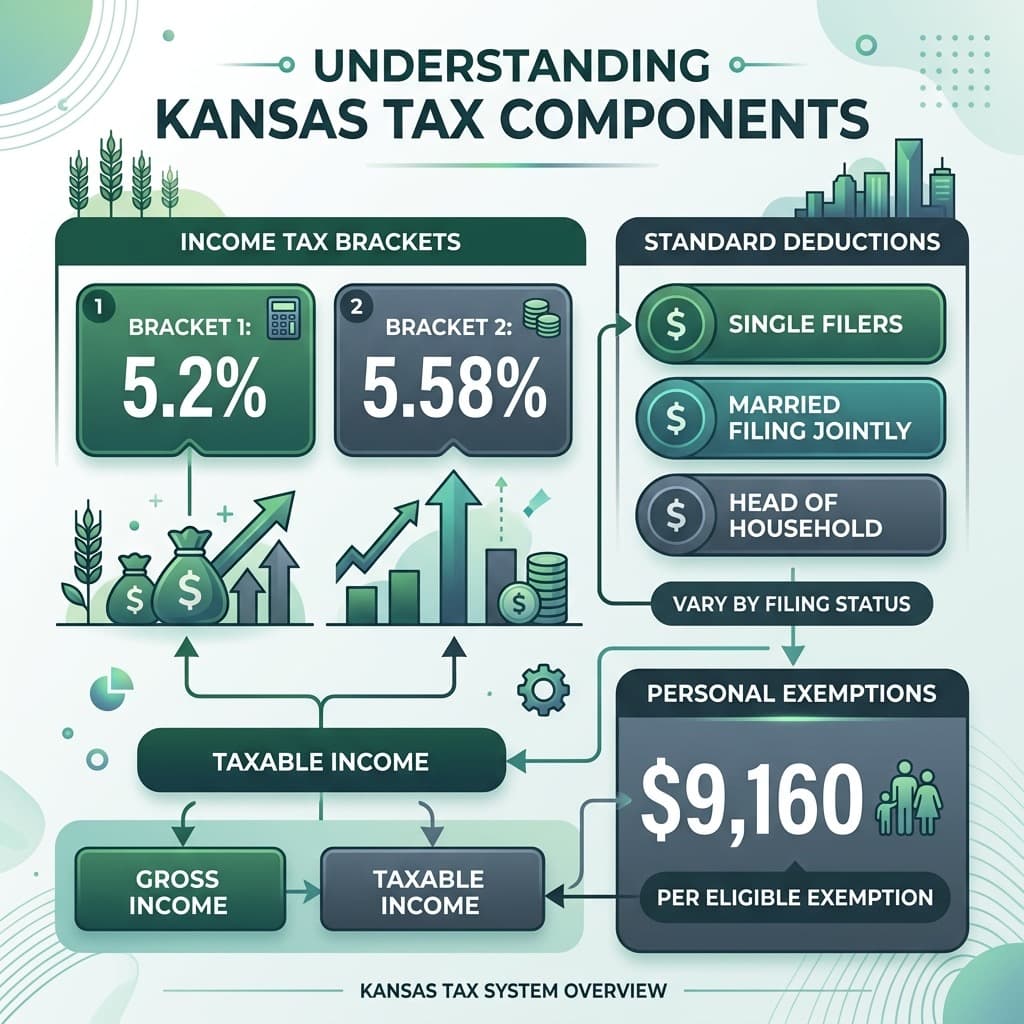
Unlike progressive states with heavy progressive brackets and minimal exemptions (such as in Delaware or California), Kansas offers a unique combination of a standard deduction and a high personal exemption allowance. Standard deductions are $3,605 for Single filers, $8,240 for Married Filing Jointly, and $6,180 for Head of Household filers.
In addition, Kansas provides a substantial personal exemption of **$9,160** for Single and Head of Household taxpayers, and **$18,320** for Married Filing Jointly. You are also allowed to subtract an additional **$2,320** for each qualified dependent claimed on your return, which reduces state taxable income and further offsets your final tax liability.
What Payroll Taxes for Leave or Disability Deductions Apply to Kansas Employees?
Employees in Kansas are exempt from worker-funded payroll deductions for state disability and paid family leave benefits. Unlike states such as Delaware (which levies 0.40% PFML) or California (which levies a 1.30% employee SDI tax), Kansas has no worker deductions for health, leave, or disability benefits.
Kansas State Unemployment Insurance (SUI) is paid entirely by employers. By state law, no portion of SUI can be withheld from your paycheck. If you live or work in a state with no income tax at all, such as Florida, you will see even fewer withholdings on your paycheck.
How Form K-4 Controls Your Take Home Wages
Your employer calculates state tax withholding using the information provided on Form K-4 (Employee’s Withholding Allowance Certificate), managed by the Kansas Department of Revenue.
Form K-4 documents your state filing status and claim allowances for children or dependents. Because Kansas uses a two-bracket tax system with standard deductions and exemptions, coordinating allowances is critical to preventing over-withholding. To coordinate your federal withholding, submit a separate Form W-4.
Comparing Kansas Tax Burden to Surrounding States
When compared to its immediate neighbors in the Midwest, Kansas offers a competitive tax structure. While states like Iowa have shifted to a flat 3.8% tax rate, and Colorado leverages a flat 4.40% tax rate, Kansas utilizes its two progressive brackets (5.2% and 5.58%).
However, Kansas offsets its slightly higher top rate of 5.58% by offering a much larger personal exemption of **$9,160** (compared to Colorado which conformed to federal standard deductions with no additional state-level exemptions). This means that lower-to-middle income workers in Kansas often shield a larger portion of their income from state tax.
Maximizing Your Take Home Pay through Pre Tax Contributions
One of the most effective strategies for minimizing both your federal and state tax bills in Kansas is to maximize your contributions to pre-tax programs. Contributing to a traditional 401(k), 403(b), or Health Savings Account (HSA) directly reduces your Adjusted Gross Income (AGI).
Since Kansas state taxable income is derived directly from your federal AGI, every dollar you contribute to a pre-tax account saves you not only federal income tax but also an additional **5.20% or 5.58%** in state taxes. For high earners, this dual tax advantage represents a significant opportunity to keep more of their hard-earned dollars.
Kansas Payroll Tax FAQs
Clear, expert answers to key questions about paycheck deductions, state tax rates, standard deductions, and personal exemptions in Kansas.
Other State Paycheck Calculators
Colorado Paycheck Calculator
Calculate take-home pay with Colorado's flat 4.40% tax rate and conformed federal standard deductions.
Iowa Paycheck Calculator
Calculate take-home pay with Iowa's flat 3.8% tax rate, conformed deductions, and personal credits.
Indiana Paycheck Calculator
Calculate take-home pay with Indiana's flat 2.95% tax rate, personal exemptions, and county taxes.
California Paycheck Calculator
Calculate payroll take-home pay in California with progressive SIT (1% - 13.3%) and 1.30% SDI deductions.