South Dakota Paycheck Calculator
Determine your net take-home salary in South Dakota. Enter your wages, pay schedule, and filing status to see federal income taxes, FICA, and take-home pay.
Estimated Take-Home Pay
per bi-weekly pay period
Detailed Deductions Breakdown
South Dakota Take-Home Pay Analysis: Earning $91,000 Annually
Single earners in SD who secure an annual W-2 salary of $91,000.00 retain approximately 80.05% of their gross earnings. This translates into a total annual net take-home pay of $72,848.50. On a bi-weekly payment schedule (26 pay periods per year), the employee receives a cash deposit of $2,801.87 per pay cycle, while total annual tax deductions drain $18,151.50 from gross wages.
With state income tax at 0.0%, federal withholdings represent the sole drain on gross earnings. The federal income tax (FIT) obligation is $11,190.00, which is computed by subtracting the standard deduction of $16,100 from gross income and applying progressive tax rates. Federal payroll contributions (FICA) subtract an additional 6.2% for Social Security ($5,642.00) and 1.45% for Medicare ($1,319.50). To contrast these rates with other states, you can utilize our federal paycheck calculator.
| Tax Category | Annual Total | Bi-Weekly Paycheck |
|---|---|---|
| Gross Salary | $91,000.00 | $3,500.00 |
| Federal Income Tax | -$11,190.00 | -$430.38 |
| Social Security Tax (6.2%) | -$5,642.00 | -$217.00 |
| Medicare Tax (1.45%) | -$1,319.50 | -$50.75 |
| South Dakota State Tax | $0.00 | $0.00 |
| Net Take-Home Pay | $72,848.50 | $2,801.87 |
The Impact of Zero State Income Tax in South Dakota
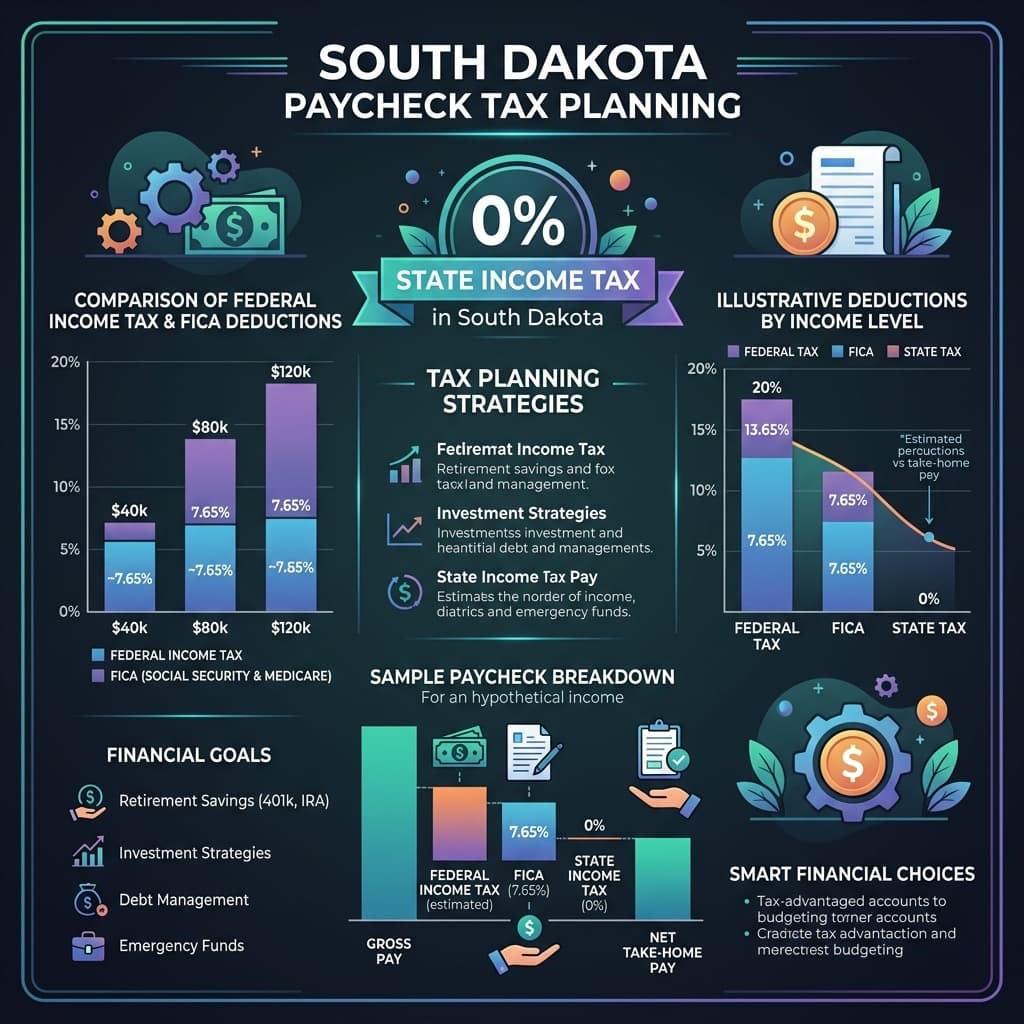
South Dakota does not impose a personal state income tax, making it one of only a few states in the country to do so. Consequently, employees working in SD have zero state income tax withheld from their payroll checks. This elimination of state tax brackets and progressive state-level rates simplifies paycheck math, leaving only federal withholdings to calculate.
To fund state operations and infrastructure, South Dakota relies heavily on a 4.2% state sales tax, local municipal taxes, tourism taxes, and business excise fees. This fiscal policy provides remote workers and corporate professionals with a significant tax advantage, as they avoid state-level deductions completely.
South Dakota Employer Payroll Taxes & SUTA Obligations
While workers in South Dakota enjoy zero state income or disability tax deductions, local employers are subject to state payroll regulations. The primary state-level employer contribution is SUTA (State Unemployment Tax Act), which goes toward reemployment assistance.
This unemployment tax applies to the first $15,000 of gross wages earned by each employee annually. New employers face a baseline SUTA rate of 1.2%, plus an administrative fee of 0.08%. Over time, an employer's rate adjusts dynamically based on the volume of unemployment claims filed. You can review current employer guidelines and registration forms directly on the South Dakota Department of Labor and Regulation portal.
Maximizing Federal Tax Savings in South Dakota via Pre-Tax Accounts
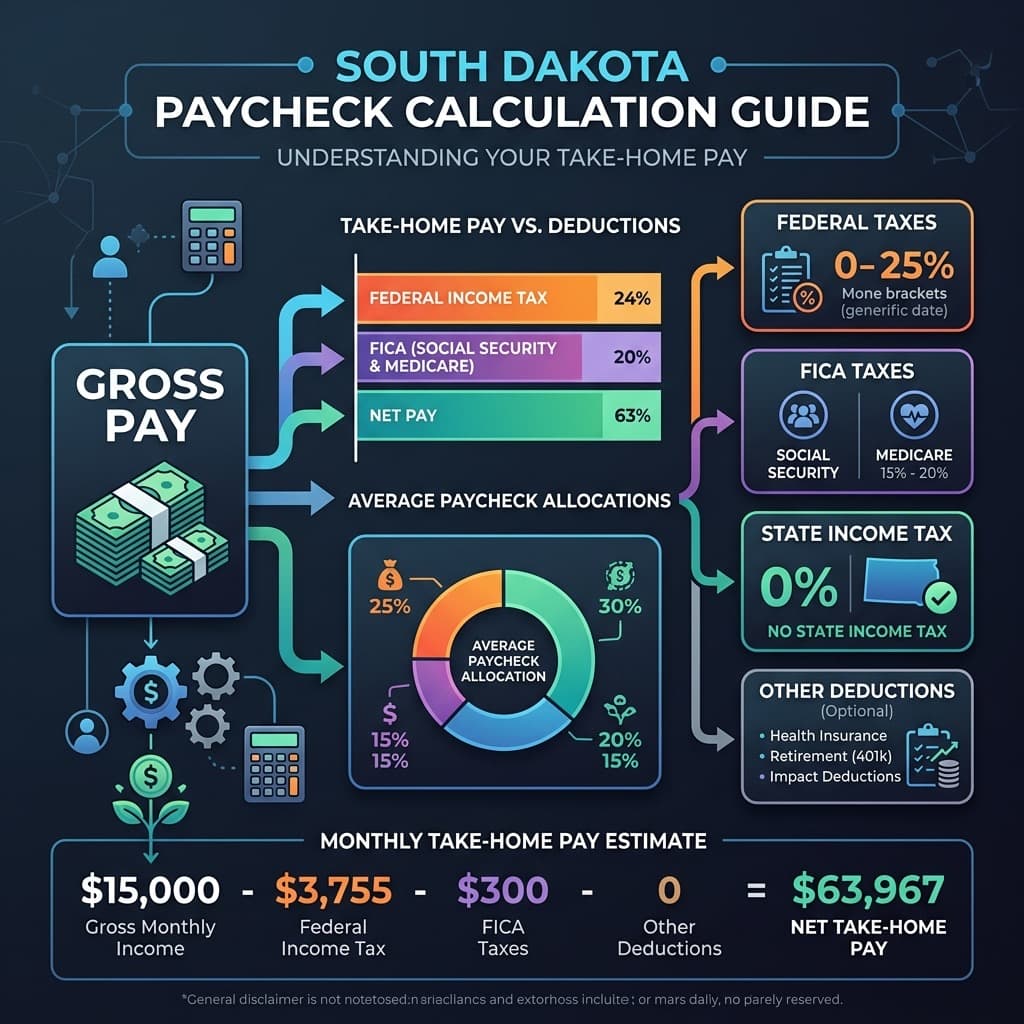
Using pre-tax benefit programs is an effective way to lower federal tax obligations. For instance, consider a married couple in South Dakota filing jointly with a gross household income of $130,000. They decide to divert 6% of their gross wages ($7,800 annually) into a traditional 401(k) retirement plan and allocate $140 bi-weekly ($3,640 annually) for employee health insurance.
FICA taxes are calculated after subtracting pre-tax health insurance premiums, which reduces the taxable FICA base to $126,360. This results in $7,834.32 in Social Security taxes (6.2%) and $1,832.22 in Medicare taxes (1.45%), for a combined FICA total of $9,666.54. Federal income tax (FIT) is computed after subtracting both the 401(k) contributions and health insurance premiums ($11,440 total) as well as the standard deduction of $32,200, resulting in a federal tax of $9,867.20.
This results in the following paycheck calculations:
- Gross Period Pay: $5,000.00
- Social Security (6.2% of FICA-taxable base): $301.32
- Medicare (1.45% of FICA-taxable base): $70.47
- South Dakota State Income Tax (SIT): $0.00
- Federal Income Tax withholding (FIT): $379.51 (annualized to $9,867.20)
- Total paycheck deductions: $1,191.30 (including pre-tax contributions and taxes)
- Net paycheck (Take-Home amount): $3,808.70
With state-level income tax at $0.00, their total annual paycheck deductions amount to $30,973.74 (including pre-tax savings, FIT, and FICA). This leaves them with a net take-home pay of $99,026.26, which breaks down to bi-weekly pay deposits of $3,808.70.
Tax Comparison: South Dakota vs. Neighboring States
South Dakota maintains a highly competitive tax standing when compared to other states in the Great Plains region. To the north, North Dakota imposes a progressive state income tax of up to 2.5%, whereas Minnesota to the east levies a steep progressive tax that reaches a top rate of 9.85%. Iowa features a flat income tax rate of 3.8%. To the south, Nebraska assesses progressive rates peaking at 4.55%, and Montana to the west has progressive brackets reaching 5.65%. South Dakota remains a clear tax haven by keeping state-level income tax at zero.
Frequently Asked Questions (FAQs)
Other State Paycheck Calculators
North Dakota Paycheck Calculator
Calculate take-home pay with North Dakota's progressive tax brackets and deductions.
Nebraska Paycheck Calculator
Calculate take-home pay with Nebraska's progressive tax brackets and standard deductions.
Minnesota Paycheck Calculator
Calculate take-home pay with Minnesota's progressive state tax brackets and deductions.
Wyoming Paycheck Calculator
Calculate take-home pay in Wyoming, featuring no state personal income tax on wages.