Minnesota Paycheck Calculator
Find out exactly what stays in your pocket after taxes. Our tool calculates federal income taxes, FICA (Social Security & Medicare) withholdings, pre-tax deductions, progressive state taxes, and the brand-new MN Paid Family and Medical Leave premium.
Estimated Take-Home Pay
per bi-weekly pay period
Detailed Deductions Breakdown
How much of your Minnesota paycheck do you actually keep?
Whether you are reviewing a job offer in Minneapolis, looking at your pay stub in Duluth, or working remotely from Rochester, you have probably noticed a significant gap between your gross salary and the amount that actually lands in your checking account. That gap represents your total tax withholdings. In Minnesota, your take-home pay is determined by federal progressive income taxes, FICA contributions (which fund Social Security and Medicare), progressive state income taxes, and the newly launched Paid Family and Medical Leave (PFML) payroll tax.
Understanding how these deductions interact is key to planning your household budget. Unlike some states that rely on flat tax structures, MN employs a highly progressive tax system. Those with higher incomes face higher marginal rates. Additionally, the state has standard deductions that reduce your overall taxable base before state rates are applied. Let's look at how this math works out in practice.
What does a $95,000 salary look like after taxes in Minnesota?
Let's trace a concrete example. Suppose you earn a gross annual salary of $95,000 as a single filer in MN and do not have any pre-tax medical premiums or retirement plans.
First, your federal income tax is calculated. After subtracting the 2026 federal standard deduction of $16,100, your federal taxable base is $78,900. Applying federal tax brackets yields an annual federal income tax bill of $12,070.00. Next, FICA taxes are calculated as 6.2% for Social Security ($5,890.00) and 1.45% for Medicare ($1,377.50).
For state taxes, Minnesota allows a standard deduction of $15,300 for single filers, lowering your state taxable income to $79,700. Under MN's graduated state brackets, the first $33,310 is taxed at 5.35% ($1,782.09), and the remaining $46,390 is taxed at 6.80% ($3,154.52), resulting in a state income tax of $4,936.61. Additionally, the new MN PFML employee contribution of 0.44% takes $418.00.
Combining all these withholdings, your total annual taxes sum to $24,692.11, leaving you with an annual net take-home pay of $70,307.89. If you get paid on a typical bi-weekly schedule—resulting in 26 pay periods over the calendar year—this baseline translates to a recurring direct deposit of $2,704.15 every two weeks. You can evaluate your standard federal brackets and withholdings by using a federal paycheck calculator to see how progressive state rates compare side-by-side.
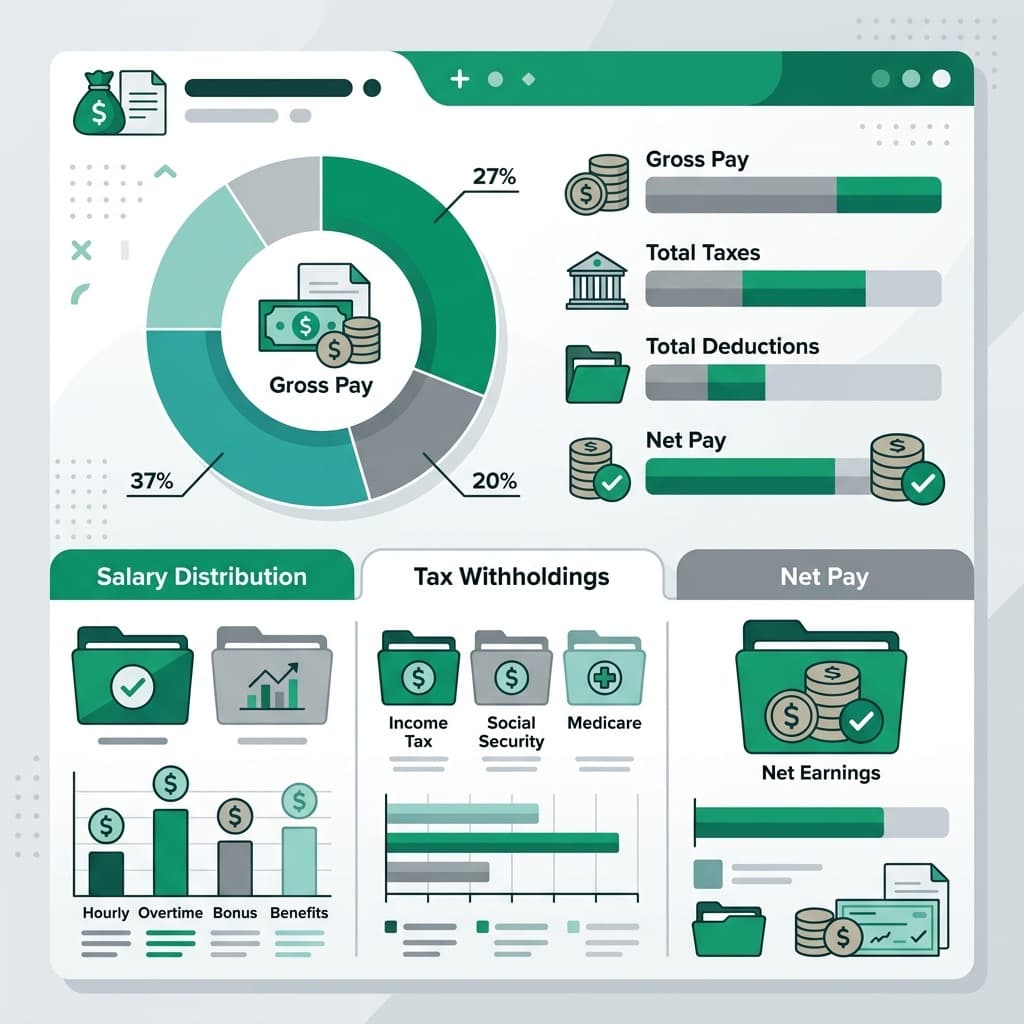
Minnesota Paycheck Distribution
Visualizing the breakdown of a $95,000 annual salary for a single taxpayer in Minnesota with no pre-tax benefits.
| Type of Withholding | Annual Total | Bi-Weekly Paycheck |
|---|---|---|
| Gross Earnings | $95,000.00 | $3,653.85 |
| Federal Income Tax | -$12,070.00 | -$464.23 |
| Social Security Tax (6.2%) | -$5,890.00 | -$226.54 |
| Medicare Tax (1.45%) | -$1,377.50 | -$52.98 |
| Minnesota State Tax (progressive) | -$4,936.61 | -$189.87 |
| Minnesota PFML Tax (0.44%) | -$418.00 | -$16.08 |
| Net Take-Home Pay | $70,307.89 | $2,704.15 |

Exemptions and deductions that shield your income from Minnesota taxes
To prevent lower-income earners from bearing too much tax burden, MN conformed to a robust standard deduction structure. This deduction directly shields a fixed amount of your gross wages from the graduated state tax.
For the 2026 tax year, the Minnesota standard deduction amounts are:
- Single / Married Filing Separately: $15,300
- Married Filing Jointly: $30,600
- Head of Household: $23,000
Additionally, while Minnesota does not offer a general personal exemption for the tax filers themselves, the state does allow a dependent exemption of $5,300 for each qualifying child or dependent in your household. This dependent exemption is subtracted directly from your gross income alongside your standard deduction, further lowering your taxable state base. You can download and fill out Form W-4MN (Minnesota Employee's Withholding Allowance Certificate) to establish these allowances with your payroll department. The forms are available on the official Minnesota Department of Revenue website.
How the new Minnesota Paid Family Leave tax affects your take-home pay
Starting January 1, 2026, Minnesota launched its state-mandated Paid Family and Medical Leave (PFML) program. This program is funded by a payroll premium applied to FICA-taxable wages (your gross wages minus pre-tax medical premiums).
The standard total premium rate is 0.88%. By default, this cost is split 50/50 between employers and employees. As a worker, your employer will automatically deduct 0.44% of your gross wages on each pay period. This premium applies to wages up to the federal Social Security wage limit ($184,500 for the 2026 program year). The funds are managed by the state to support employees taking paid leave for family care, medical conditions, or welcoming a new child.
How do pre-tax deductions change a $112,000 salary check?
Electing workplace benefits like health insurance or contributing to a traditional retirement plan lowers your overall tax exposure. Let's trace a taxpayer earning a gross annual salary of $112,000 on a bi-weekly payroll cycle (yielding gross period earnings of $4,307.69). They choose the following:
- Contribute 5% of their gross paycheck to a traditional, pre-tax 401(k) ($215.38 per period).
- Pay a $120.00 pre-tax premium per paycheck for health insurance under a Section 125 plan.
These benefits reduce your taxable income bases in different ways:
- Health Insurance Premiums: Fully tax-exempt under Section 125. They lower your taxable base for federal income tax, state income tax, FICA, and MN's PFML. In this cycle, your FICA and PFML taxable base drops from $4,307.69 to $4,187.69.
- Traditional 401(k) Savings: Tax-deferred, meaning they lower your taxable base for federal and state income taxes, but they remain subject to FICA (Social Security & Medicare) and PFML taxes. Your taxable base for federal and state income taxes drops to $3,972.31 per period.
Applying these variables yields the following bi-weekly paycheck calculations:
- Gross Period Pay: $4,307.69
- Social Security Tax (6.2% of FICA base): $259.64
- Medicare Tax (1.45% of FICA base): $60.72
- Federal Income Tax (FIT): $534.29 (based on annualized base minus federal standard deduction)
- Minnesota State Income Tax: $211.53 (computed on progressive brackets)
- Minnesota PFML Tax (0.44% of FICA base): $18.43
- Total Deductions: $1,420.00 (includes all taxes, health premiums, and 401k savings)
- Net Pay (Take-Home Check): $2,887.69
Comparing Minnesota's payroll tax burden to neighboring states
Evaluating a job offer or planning a move in the Upper Midwest involves looking closely at varying tax rules. If you commute or work remotely, you will notice distinct differences in payroll structures across state borders.
If you commute to the east, you can check your estimated take-home pay in Wisconsin, which uses progressive brackets ranging from 3.50% to 7.65%. To the southeast, you can see how flat tax rates compare using our Illinois paycheck calculator (4.95% flat state tax with no local taxes on wages) or our Indiana paycheck calculator (2.95% flat state tax plus county taxes).
If you are looking south, Iowa recently transitioned to a flat individual income tax rate of 3.8% for the 2026 tax year, down from its old graduated system. Additionally, if you look east across the Lakes, Michigan uses a flat rate of 4.25% alongside municipal city taxes in cities like Detroit.
Minnesota Payroll Tax FAQs
Clear, expert answers to key questions about paycheck deductions, state tax rates, and the new PFML program in Minnesota.
Other State Paycheck Calculators
Indiana Paycheck Calculator
Calculate take-home pay with Indiana's flat rate (2.95%) and county tax adjusters.
Iowa Paycheck Calculator
Calculate take-home pay with Iowa's flat rate (3.8%) and conformed standard deductions.
Illinois Paycheck Calculator
Calculate take-home pay with Illinois's flat rate (4.95%) and personal exemptions.
Michigan Paycheck Calculator
Calculate take-home pay with Michigan's flat rate (4.25%) and local city income taxes.