Wisconsin Paycheck Calculator
Find your W-2 take-home earnings in WI. Provide your gross pay, filing status, frequency, and benefits to compute federal withholdings, FICA taxes, and progressive state income tax.
Estimated Take-Home Pay
per bi-weekly pay period
Detailed Deductions Breakdown
Wisconsin W-2 Paycheck Math: Take-Home Pay on a $89,000 Salary
Wisconsin W-2 payroll withholding calculations determine your net take-home salary based on progressive state income tax brackets and a sliding scale standard deduction. For an individual earning a W-2 salary of $89,000.00 in WI who files as Single and has no pre-tax deductions, the net take-home pay amounts to exactly $67,587.92 annually. This converts to bi-weekly pay deposits of $2,599.54 per pay period. In total, payroll taxes and state withholdings consume $21,412.08 of your gross salary.
The Wisconsin standard deduction employs an income-sensitive phase-out rather than a fixed exemption. For Single taxpayers, the baseline deduction starts at $13,560 but is reduced by 12% of the amount by which income exceeds $19,550. On a gross salary of $89,000, this leaves a standard deduction of $5,226.00, resulting in a state taxable income of $83,774.00. Wisconsin state income tax (SIT) withholdings deduct $3,853.58 from your earnings. In comparison, federal income tax (FIT) takes $10,750.00 after applying the federal standard deduction of $16,100, and FICA withholdings total $6,808.50 ($5,518.00 for Social Security and $1,290.50 for Medicare). To run calculations for other states, utilize our federal paycheck calculator homepage.
| Withholding Category | Annual Amount | Bi-Weekly Paycheck |
|---|---|---|
| Gross W-2 Earnings | $89,000.00 | $3,423.08 |
| Federal Income Tax (FIT) | -$10,750.00 | -$413.46 |
| Social Security Tax (6.2%) | -$5,518.00 | -$212.23 |
| Medicare Tax (1.45%) | -$1,290.50 | -$49.63 |
| Wisconsin State Income Tax | -$3,853.58 | -$148.21 |
| Net Take-Home Pay | $67,587.92 | $2,599.54 |
Understanding Wisconsin's Progressive Brackets and SSSD Phases
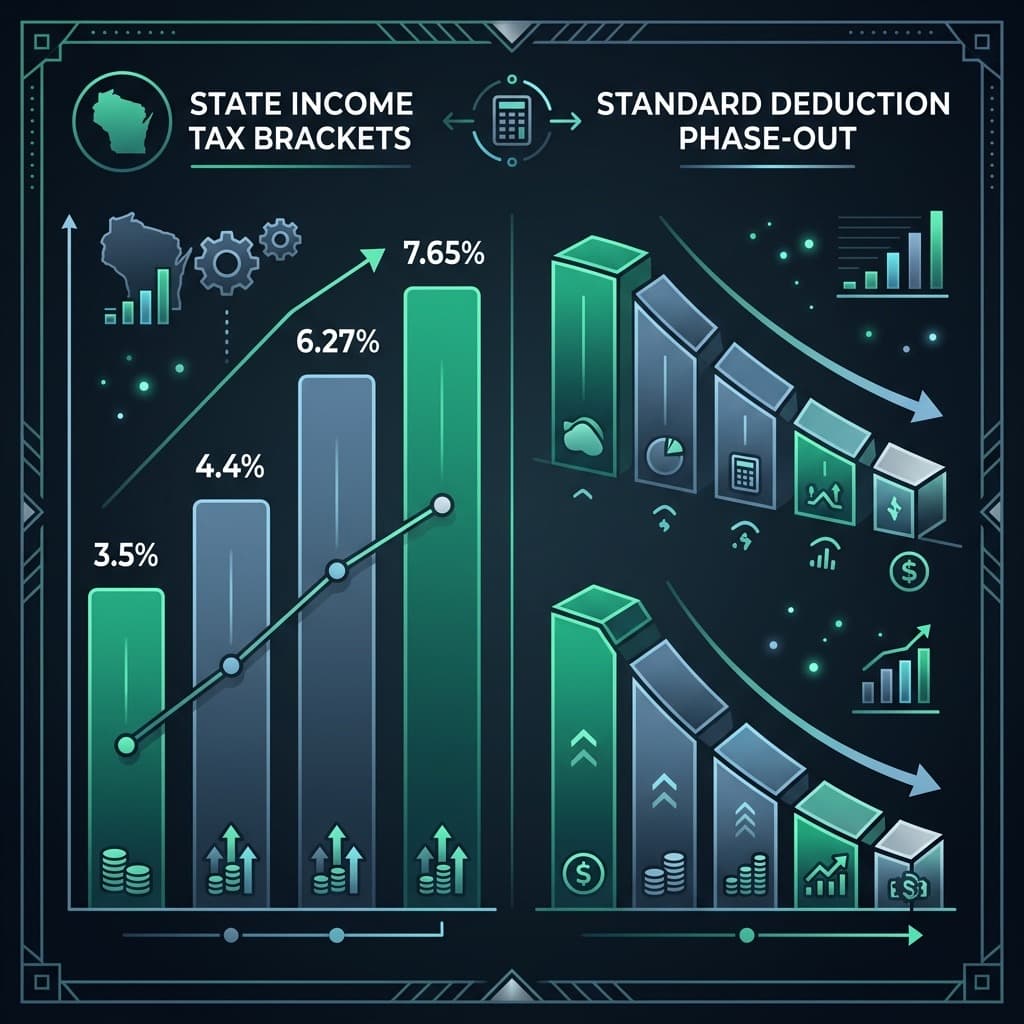
The state of Wisconsin levies personal income tax across four marginal brackets. For Single filers, the rates begin at 3.50% on taxable wages up to $14,680, rising to 4.40% on wages up to $50,480, 5.30% on wages up to $323,290, and a top marginal rate of 7.65% on taxable earnings above $323,290. Married couples filing jointly face the same tax rates, but with expanded bracket thresholds ($0 - $19,580 at 3.50%, $19,580 - $67,300 at 4.40%, $67,300 - $431,040 at 5.30%, and 7.65% above $431,040).
The Sliding Scale Standard Deduction (SSSD) serves as the primary state-specific shield. For Married Joint filers, a maximum deduction of $25,110 applies for incomes under $28,210. As combined wages exceed $28,210, the deduction decreases by 19.778% of the excess income, phasing out completely to $0 for incomes above $155,169. For Head of Household filers, the deduction starts at $17,520 and phases out by 22.515% of income exceeding $19,550.
Employer Payroll Compliance and Wisconsin Unemployment Insurance (SUTA)
W-2 workers in Wisconsin do not have employee-level withholdings for state disability or paid family leaves. However, WI business owners must contribute to the State Unemployment Tax Act (SUTA) fund.
SUTA premiums apply to a set employee wage base determined by state law. New employers are assessed a standard state base rate, whereas established business owners receive customized tax rates based on past unemployment claims records. For formal filings, registration services, and calendar deadlines, check the official Wisconsin Department of Workforce Development portal.
Wisconsin Paycheck Breakdown: How Pre-Tax Plans Reduce SIT and FIT
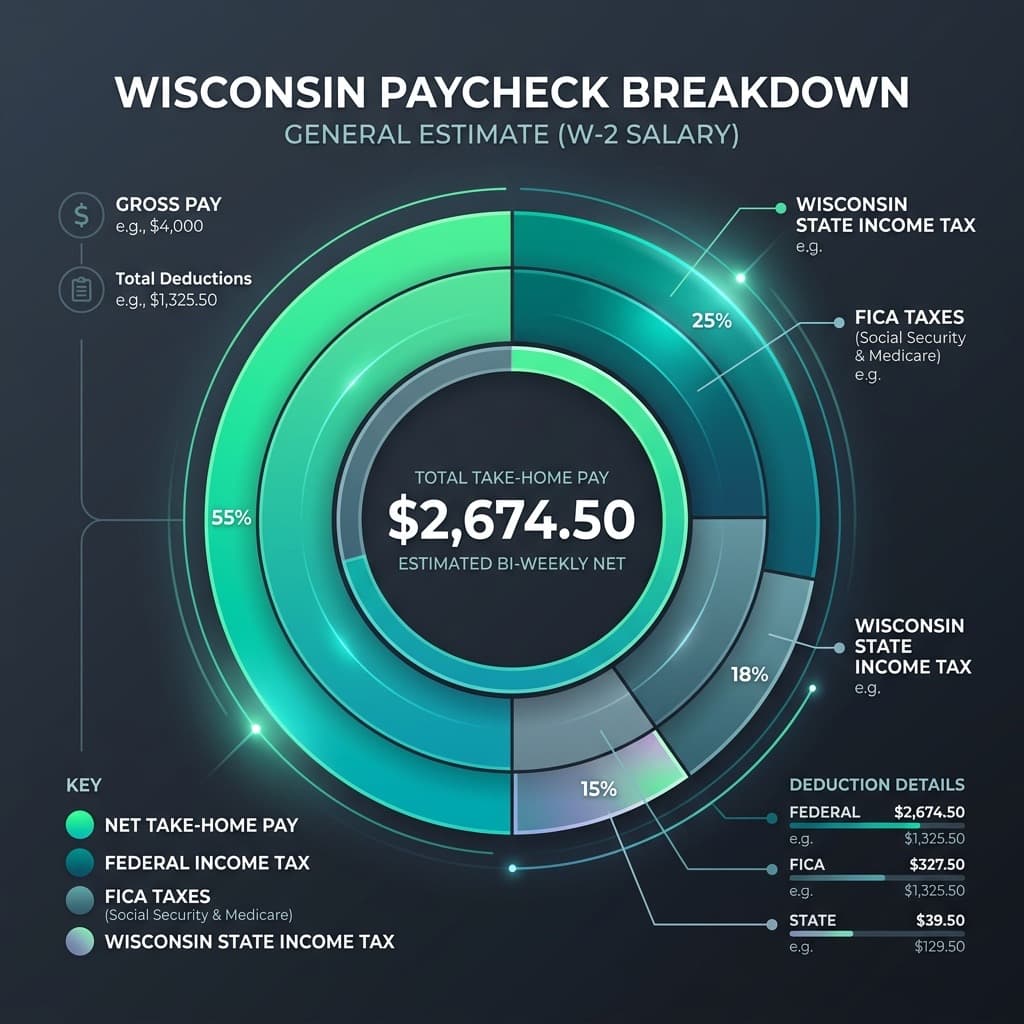
Pre-tax retirement accounts and medical plans directly decrease federal and state income tax liabilities. Let's analyze a married couple in WI filing jointly with an annual W-2 combined salary of $138,000.00. The couple allocates 6% of their gross pay ($8,280.00 annually) to a traditional 401(k) and pays $140.00 bi-weekly ($3,640.00 annually) in pre-tax health insurance premiums.
FICA taxes are calculated after subtracting health premium deductions, leaving a taxable FICA base of $134,360. This results in $8,330.32 in Social Security (6.2%) and $1,948.22 in Medicare (1.45%), making a FICA total of $10,278.54. Federal income tax (FIT) is computed after subtracting both pre-tax benefits ($11,920 total) and the federal standard deduction of $32,200, resulting in a federal tax of $10,769.60 on taxable wages of $93,880.00.
For state taxes, Wisconsin adjusted gross income (AGI) matches the pre-tax base of $126,080.00. Using the SSSD formula, their state standard deduction is calculated as $25,110 - ($126,080 - $28,210) * 19.778% = $5,753.27. Subtracting this from AGI yields a state taxable income of $120,326.73. Applying Wisconsin progressive brackets results in an annual state tax of $5,595.40.
This results in the following paycheck calculations:
- Gross Period Pay: $5,307.69
- Social Security (6.2% of FICA-taxable base): $320.40
- Medicare (1.45% of FICA-taxable base): $74.93
- Wisconsin State Income Tax (SIT): $215.21 (annualized to $5,595.40)
- Federal Income Tax withholding (FIT): $414.22 (annualized to $10,769.60)
- Total paycheck deductions: $1,483.21 (including pre-tax contributions and taxes)
- Net paycheck (Take-Home amount): $3,824.48
Combining pre-tax allocations, FIT, FICA, and state income tax, total deductions equal $38,563.54. This leaves a net take-home pay of $99,436.46, translating to bi-weekly pay deposits of exactly $3,824.48.
Midwestern Tax Comparison: Wisconsin vs. Neighboring States
Wisconsin's progressive tax brackets and sliding scale deduction create a unique tax burden compared to bordering Midwestern states. To the south, Illinois employs a flat state income tax rate of 4.95%. To the west, Iowa has transitioned to a flat state income tax rate of 3.8%. To the north, Minnesota imposes progressive state tax brackets reaching a high of 9.85%, while to the east across Lake Michigan, Michigan uses a flat state income tax rate of 4.25%. Individuals evaluating job offers in the Great Lakes region can use these rates to model local disposable income.
Frequently Asked Questions (FAQs)
Other State Paycheck Calculators
Illinois Paycheck Calculator
Calculate take-home pay with Illinois' flat tax rate (4.95%) and standard deductions.
Minnesota Paycheck Calculator
Calculate take-home pay with Minnesota's progressive state tax brackets and deductions.
Iowa Paycheck Calculator
Calculate take-home pay with Iowa's flat tax rate and standard deductions.
Michigan Paycheck Calculator
Calculate take-home pay with Michigan's flat tax rate and local city income taxes.