Tennessee Paycheck Calculator
Calculate your net take-home salary in Tennessee. Enter your gross income, pay frequency, filing status, and pre-tax deductions to see federal income taxes, FICA, and net paycheck amounts.
Estimated Take-Home Pay
per bi-weekly pay period
Detailed Deductions Breakdown
W-2 Paycheck Breakdown in the Volunteer State: $86,000 Annual Salary
If you earn an annual W-2 wage of $86,000.00 while living and working in TN, your net annual take-home salary will be $69,331.00. This equates to bi-weekly paychecks of $2,666.58 under a standard 26-period pay cycle. Over the course of the tax year, federal agencies deduct a cumulative total of $16,669.00 from your gross salary.
Because Tennessee does not levy a state income tax, federal taxes make up 100% of these payroll withholdings. For a Single filer claiming no standard adjustments, Federal Income Tax (FIT) consumes $10,090.00. Federal insurance payroll contributions (FICA) deduct another 6.2% for Social Security ($5,332.00) and 1.45% for Medicare ($1,247.00). To run simulations for other states, you can visit our federal paycheck calculator home page.
| Tax Type | Annual Total | Bi-Weekly Paycheck |
|---|---|---|
| Gross Wages | $86,000.00 | $3,307.69 |
| Federal Income Tax | -$10,090.00 | -$388.08 |
| Social Security Tax (6.2%) | -$5,332.00 | -$205.08 |
| Medicare Tax (1.45%) | -$1,247.00 | -$47.96 |
| Tennessee State Tax | $0.00 | $0.00 |
| Net Take-Home Pay | $69,331.00 | $2,666.58 |
Constitutional Bans on Income Taxes in Tennessee
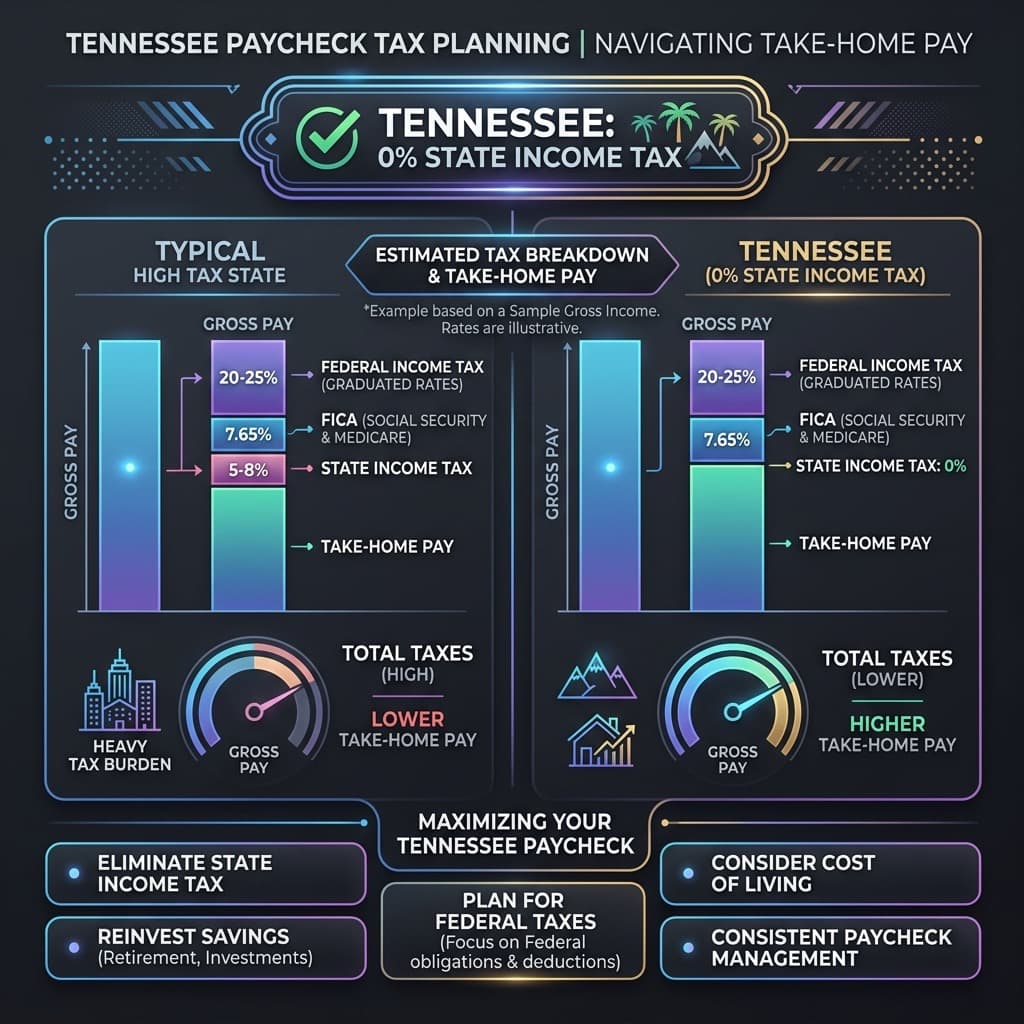
The Tennessee Constitution explicitly bans the taxation of personal wages and salaries. While the state historically levied a limited tax on investment earnings known as the Hall Income Tax, that policy was completely phased out. As a result, TN is one of a select few states that features a true 0% state income tax.
Instead of relying on income taxes, Tennessee supports state funding and infrastructure through one of the highest state sales tax rates in the nation (currently 7% state-level plus local county options up to 2.75%), along with franchise fees and business excise taxes. This fiscal framework allows W-2 employees to keep a larger share of their earnings on every paycheck.
Tennessee SUTA Caps & Unemployment Insurance Rules
Although employees do not face any state-level income tax or disability deductions, employers in Tennessee must pay state-specific payroll taxes. The main obligation is the State Unemployment Tax Act (SUTA) contribution.
Tennessee SUTA taxes are paid on the first $7,000 of gross wages earned by each worker. The standard entry rate for new employers is 2.7%, but experienced employers pay rates that range from 0.01% to 10.0%, depending on their historical unemployment claims. More details regarding these employer obligations can be accessed on the Tennessee Department of Labor and Workforce Development site.
Tennessee Paycheck Deductions: Pre-Tax Benefits Breakdown
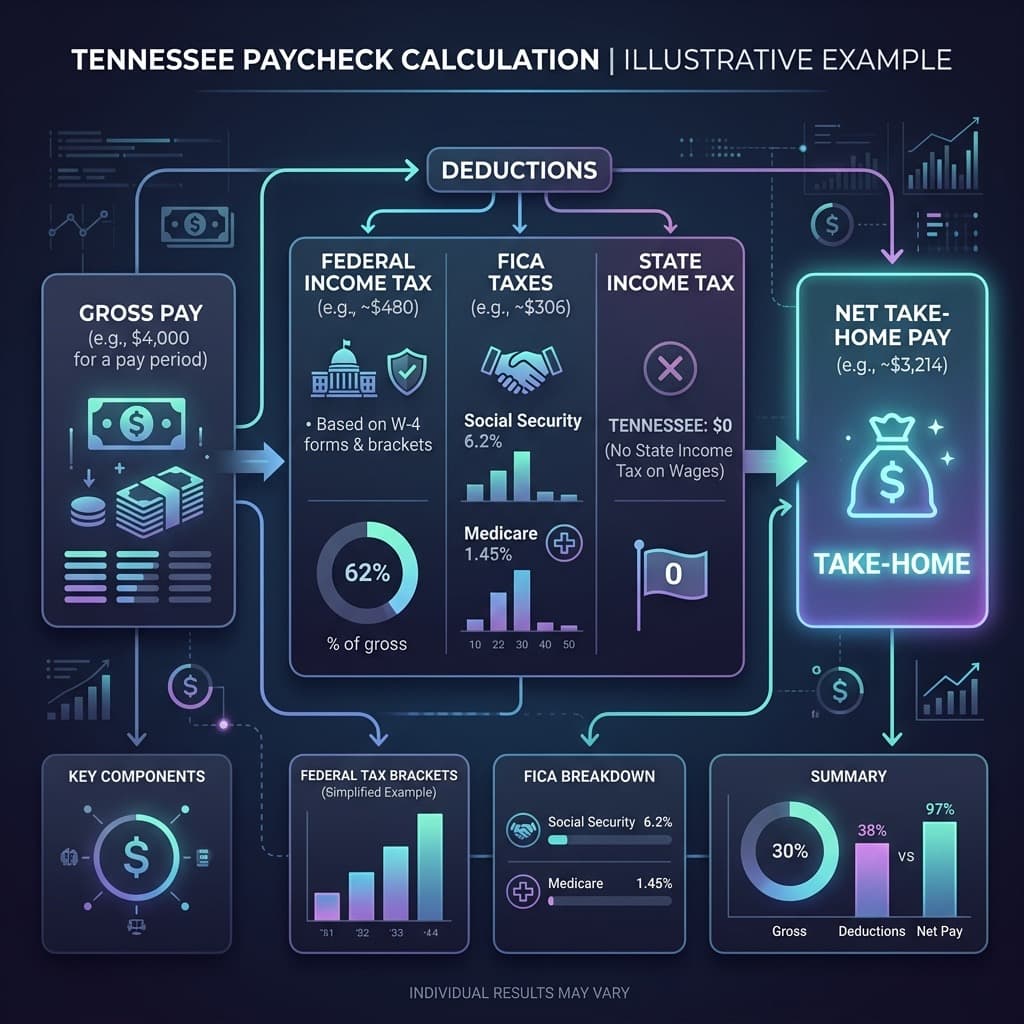
Even without a state income tax, utilizing pre-tax benefits can yield significant savings on federal taxes. Take a married couple in Tennessee filing jointly with a combined gross annual income of $140,000. They opt to place 5% of their gross earnings ($7,000 annually) into a traditional 401(k) plan and dedicate $150 bi-weekly ($3,900 annually) toward employer-sponsored health premiums.
FICA taxes are calculated after subtracting health premiums, giving a taxable FICA base of $136,100. This results in $8,438.20 for Social Security (6.2%) and $1,973.45 for Medicare (1.45%), for a FICA sum of $10,411.65. Federal income tax (FIT) is computed after subtracting both the 401(k) and health premium contributions ($10,900) and the standard joint deduction of $32,200, resulting in a taxable income of $96,900 and a tax of $11,132.00.
This results in the following paycheck calculations:
- Gross Period Pay: $5,384.62
- Social Security (6.2% of FICA-taxable base): $324.55
- Medicare (1.45% of FICA-taxable base): $75.90
- Tennessee State Income Tax (SIT): $0.00
- Federal Income Tax withholding (FIT): $428.15 (annualized to $11,132.00)
- Total paycheck deductions: $1,247.84 (including pre-tax contributions and taxes)
- Net paycheck (Take-Home amount): $4,136.78
Because Tennessee levies no state income tax, state-level withholdings are $0.00. Adding their pre-tax retirement, medical premiums, FIT, and FICA totals, their annual payroll deductions equal $32,443.65. This results in an annual net take-home salary of $107,556.35, which translates to bi-weekly pay deposits of $4,136.78.
Regional Comparison: Tennessee vs. Bordering States
Tennessee’s zero-tax policy represents a major financial benefit when compared to neighboring states in the Mid-South region. Kentucky to the north levies a flat income tax rate of 3.5%. Virginia to the northeast has a progressive tax structure with a top rate of 5.75%, and North Carolina features a flat rate of 3.99%. Georgia to the south charges a flat tax rate of 4.99%, while Alabama assesses progressive rates up to 5.0%. Mississippi to the southwest charges a flat rate of 4.7%, and Arkansas to the west has progressive rates up to 4.7%. Tennessee stands out in the region by keeping state wage taxes completely at zero.
Frequently Asked Questions (FAQs)
Other State Paycheck Calculators
Kentucky Paycheck Calculator
Calculate take-home pay with Kentucky's flat tax rate and local occupational license fees.
Georgia Paycheck Calculator
Calculate take-home pay with Georgia's flat 4.99% tax rate and standard deductions.
North Carolina Paycheck Calculator
Calculate take-home pay with North Carolina's flat state tax rate and deductions.
Virginia Paycheck Calculator
Calculate net pay with Virginia's progressive state income tax brackets and deductions.